
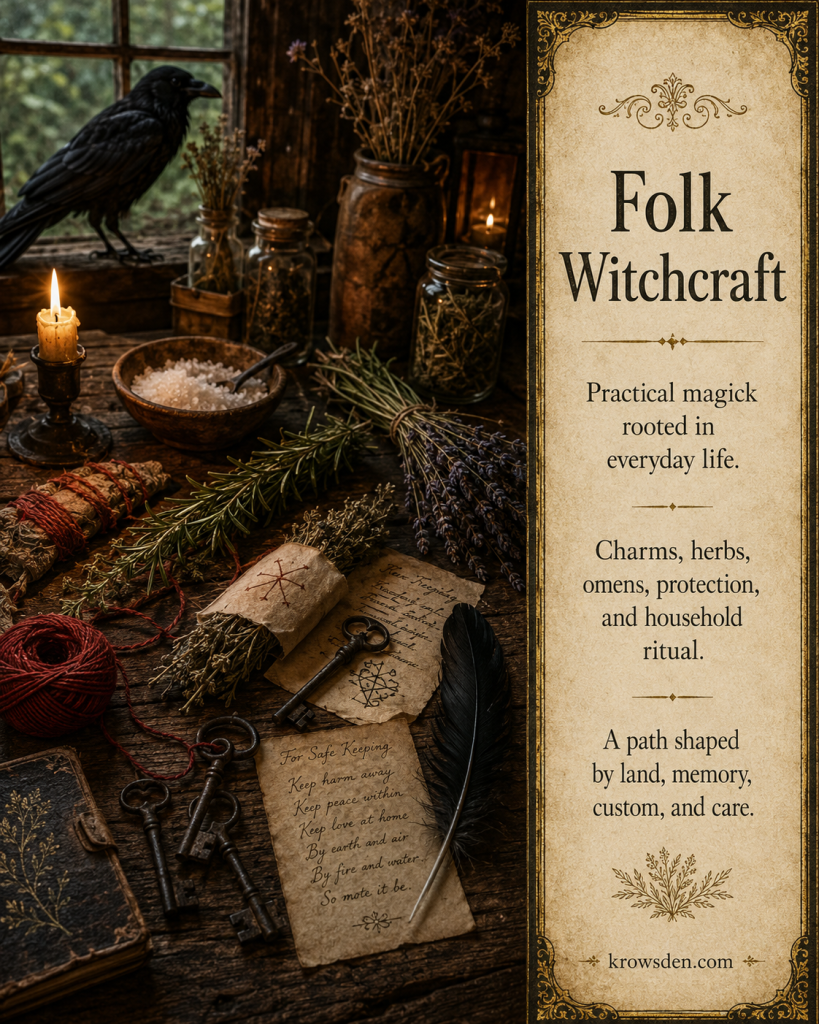
A warm cinematic folk-magick cottage scene with a candlelit wooden table, charm bundles, red thread, old keys, salt bowl, herbs, black feather, handwritten charms, and a raven near the window.
Folk witchcraft is a practical magical path rooted in everyday life, old customs, household protection, charms, herbs, omens, local folklore, and the quiet wisdom passed through communities.
It is not one single tradition.
It changes from place to place, family to family, culture to culture, and landscape to landscape.
A folk witch may work with candles, salt, herbs, knots, charms, prayers, spoken words, household objects, seasonal signs, local spirits, ancestors, protective symbols, and simple rituals woven into daily life.
At Krow’s Den, folk witchcraft belongs beside herbal medicine, correspondences, divination, sacred paths, witchcraft traditions, protection work, and practical beginner magick.
What Is Folk Witchcraft?
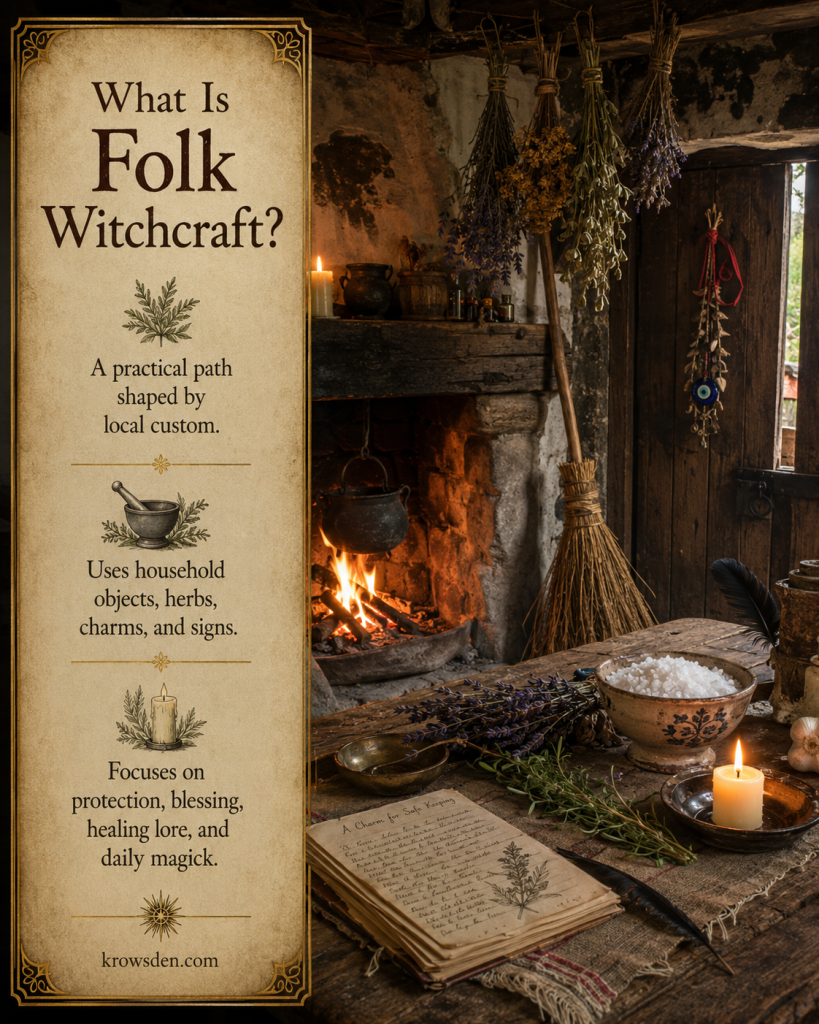
An old village hearth and kitchen table with protective charms, herbs, candles, a broom, and a doorway symbol, showing practical everyday magick.
Folk witchcraft is a form of practical magick shaped by local customs, household traditions, community beliefs, land-based folklore, and everyday spiritual practice.
It often focuses on useful results rather than elaborate ceremony.
A folk witch may:
- protect the home,
- bless a doorway,
- read signs in nature,
- use herbs,
- create charms,
- cleanse a space,
- keep family traditions,
- mark seasonal changes with simple rituals.
Folk witchcraft is closely connected to cunning craft, charm work, household magick, rural healing lore, protective customs, and regional spiritual traditions.
It is not limited to one country or one historical period.
Every culture has had its own ways of working with luck, protection, healing, omens, blessings, ancestors, land, and unseen forces.
The heart of folk witchcraft is practical relationship.
It asks what works, what has meaning, what protects, what heals, and what keeps people connected to place, memory, and spirit.
Continue exploring: Witchcraft Traditions
What Does a Folk Witch Believe?

A folk witch often believes that magick can live inside ordinary things.
A key can protect a threshold.
Salt can mark a boundary.
A candle can carry intention.
A herb can hold memory, healing, or symbolic power.
A spoken charm can focus the will.
A repeated household ritual can become sacred through care, belief, and use.
Folk witchcraft usually values lived experience, observation, repetition, and inherited wisdom.
It does not always need complex theory.
A folk witch believes the home, garden, crossroads, kitchen, hearth, doorway, local plants, dreams, weather, animals, and seasonal changes can all carry signs and meaning.
This path is often humble and practical.
It is less about looking mystical and more about living with awareness.
Continue exploring: What Is Magick
What Do Folk Witches Do?

Folk witches often practise protection, cleansing, blessing, charm-making, herbal work, candle magick, divination, omen reading, household rituals, seasonal observances, and practical spellwork.
They may bless a home before moving in.
They may hang protective herbs near a doorway.
They may place salt near a threshold.
They may light a candle for clarity, courage, peace, protection, or healing.
They may keep a charm bag, write a petition, tie knots with intention, read signs in birds or weather, or use a family recipe as a form of inherited magic.
Some folk witches work with ancestors, land spirits, saints, household spirits, local folklore, or personal guides.
Others keep the practice simple and secular.
Folk witchcraft is flexible because it grows from real life.
It adapts to the home, the land, the need, and the person practising it.
Continue exploring: Correspondences
What Tools Does a Folk Witch Use?

A folk witch does not need expensive tools.
Many folk witchcraft tools are ordinary household items.
Common tools may include:
- candles,
- salt,
- thread,
- keys,
- jars,
- bowls,
- pins,
- bells,
- brooms,
- written charms,
- cloth bags,
- herbs,
- water,
- oil,
- bread,
- eggs,
- coins,
- mirrors,
- iron objects,
- scissors,
- needles,
- ribbons,
- stones,
- feathers
- journal,
- grimoire,
- prayer book,
- recipe book,
- family notebook,
- tarot deck,
- pendulum,
- divination objects.
The tool is not powerful because it is rare.
It becomes meaningful because of its purpose, symbolism, history, use, and intention.
In folk witchcraft, a plain object can become sacred when it is chosen carefully and used with focus.
Continue exploring: Tarot
How Do Folk Witches Work With Charms and Household Magick?

Charms are one of the oldest and most practical parts of folk witchcraft.
A charm may be spoken, written, worn, buried, carried, hung, hidden, burned, washed away, or placed somewhere meaningful.
Backend Metadata
Household magick often focuses on protection, luck, peace, health, prosperity, sleep, love, cleansing, and harmony.
A folk witch might:
- place a charm above a door,
- tuck herbs into a small bag,
- write a blessing for the home,
- keep protective objects near the bed,
- use repeated words while cleaning.
Doorways, windows, hearths, beds, kitchens, gardens, and thresholds are especially important because they mark places of entry, rest, nourishment, and transition.
Historically, many cultures used protective objects and symbols to guard against harm, bad luck, envy, spirits, illness, or unwanted influence.
In modern folk witchcraft, charm work can be adapted safely and respectfully for personal use.
Continue exploring: The History of witchcraft
How Do Folk Witches Use Herbs, Plants, and Everyday Materials?
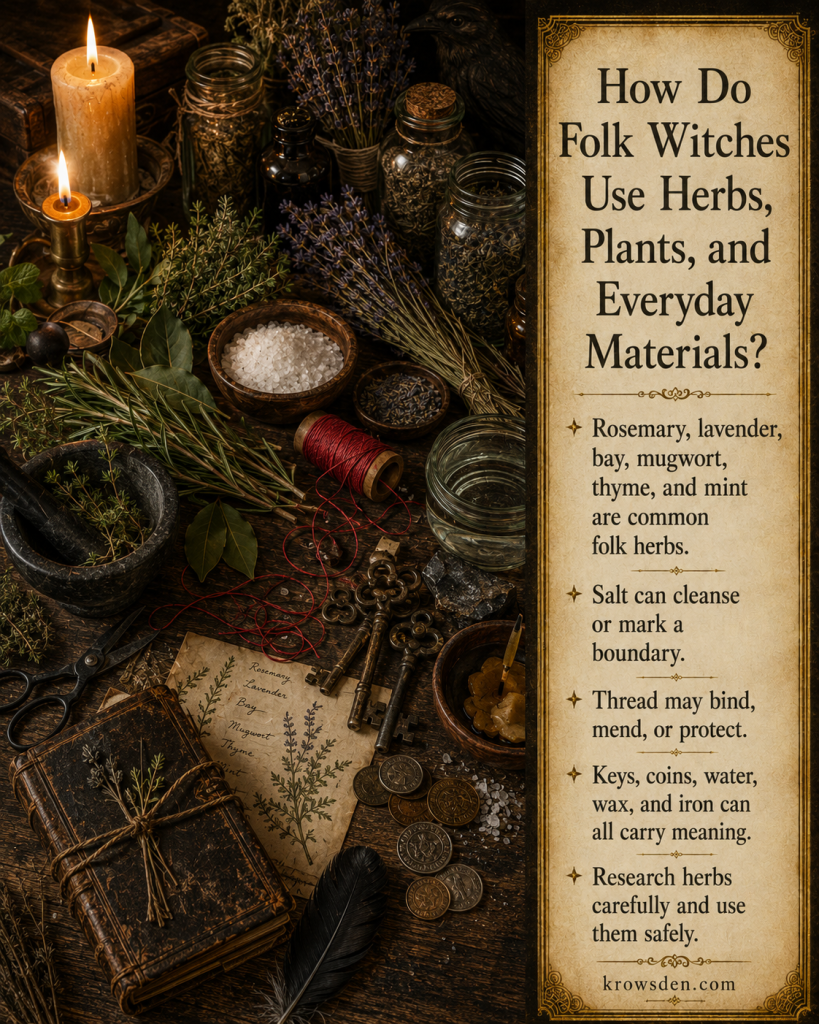
Folk witches often work with herbs, plants, roots, flowers, seeds, bark, spices, food, salt, water, smoke, oil, thread, wax, and household materials.
Herbs may be used in sachets, teas, baths, washes, incense, floor washes, charm bags, protection jars, sleep pillows, seasonal decorations, or altar work.
Common folk-magick herbs may include rosemary, lavender, sage, mugwort, thyme, bay, basil, chamomile, yarrow, mint, garlic, nettle, and lemon balm.
Everyday materials also matter.
Salt may represent cleansing or boundary.
Thread may represent binding, mending, connection, or protection.
Keys may represent access, secrecy, locking, and unlocking.
Iron may represent strength and protection in some traditions.
Coins may represent luck, payment, offering, or prosperity.
A folk witch learns the meaning of materials through history, family tradition, local folklore, correspondences, and personal practice.
Safety matters deeply when working with herbs.
Never ingest, burn, or apply herbs to the skin without checking identification, toxicity, allergies, pregnancy cautions, pet safety, and medication interactions.
Continue exploring: Herbal Medicine
How Do Folk Witches Work With Protection and Cleansing?
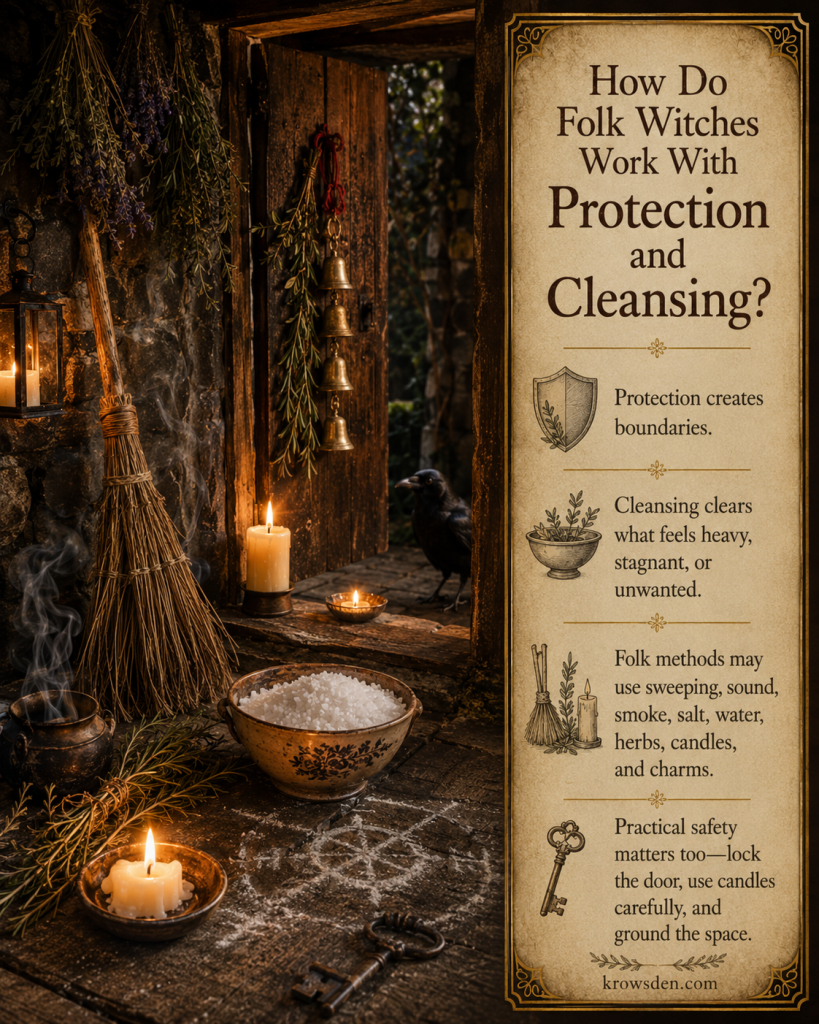
A candlelit threshold with salt, broom, bells, smoke, herbs, iron key, and protective markings.
Protection and cleansing are central to folk witchcraft.
Protection is about creating boundaries.
Cleansing is about clearing what feels stagnant, heavy, harmful, or unwanted.
A folk witch may cleanse a home with sound, smoke, water, sweeping, salt, prayer, spoken words, herbal washes, candlelight, or practical cleaning.
They may protect a space with charms, threshold objects, written symbols, iron, bells, herbs, salt lines, protective jars, knots, candles, or doorway blessings.
The goal is not fear.
The goal is stability, peace, clarity, and safety.
Good folk protection is practical as well as magical.
Lock the door.
Check the smoke alarm.
Keep emergency contacts.
Use safe candles.
Keep pets away from toxic plants.
Clean the space physically as well as spiritually.
Folk witchcraft works best when the magical and practical support each other.
Continue exploring: Correspondences
How Do Folk Witches Use Divination, Omens, and Signs?

A rustic table with tarot cards, tea cup, candle, bird feather, weather journal, bones or charms, and moonlit window.
Folk witchcraft often pays attention to signs.
These signs may come through dreams, weather, animals, repeated symbols, sudden feelings, household patterns, candle behaviour, cards, pendulums, bones, charms, coins, tea leaves, or natural events.
A folk witch might notice the direction of the wind, the behaviour of birds, the way a candle burns, or a repeated dream image.
They may use divination to ask for guidance before making a decision, beginning a spell, travelling, protecting the home, or understanding a situation.
Discernment is important.
Not every strange event is a sign.
Not every dream is a warning.
Not every feeling needs to be acted on.
A grounded folk witch observes patterns over time instead of reacting to every small thing.
Divination should support wisdom, not replace common sense.
Continue exploring: Divination —
Can You Practise Folk Witchcraft Without Knowing Your Ancestry?
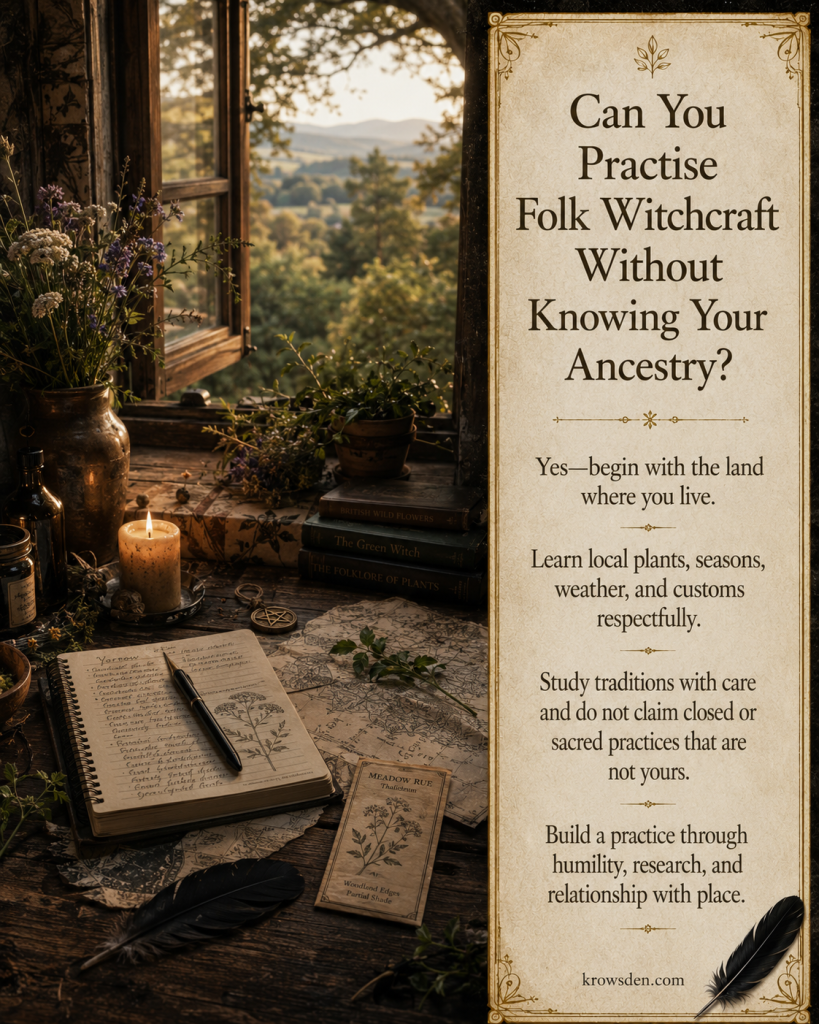
A modern home altar with local plants, notebook, candle, and map, showing respectful personal practice.
Yes, you can practise folk witchcraft without knowing your ancestry.
Folk witchcraft is often connected to heritage, but it is not limited to bloodline.
You can begin with the land where you live, the seasons around you, the plants you can safely identify, the household customs you choose to build, and the protective practices that feel meaningful.
You can also study traditions respectfully without claiming what is not yours.
Some folk practices are open, shared, and widely adapted.
Others are culturally specific, initiatory, closed, sacred, or tied to living communities.
Respect matters.
Do not take from cultures without learning context.
Do not claim authority over traditions you have not been taught.
Do not turn sacred practices into decoration.
A modern folk witch can build a strong practice through research, humility, local awareness, and honest relationship with place.
Continue exploring: Sacred Paths — [add page link]
How Do You Start Folk Witchcraft?
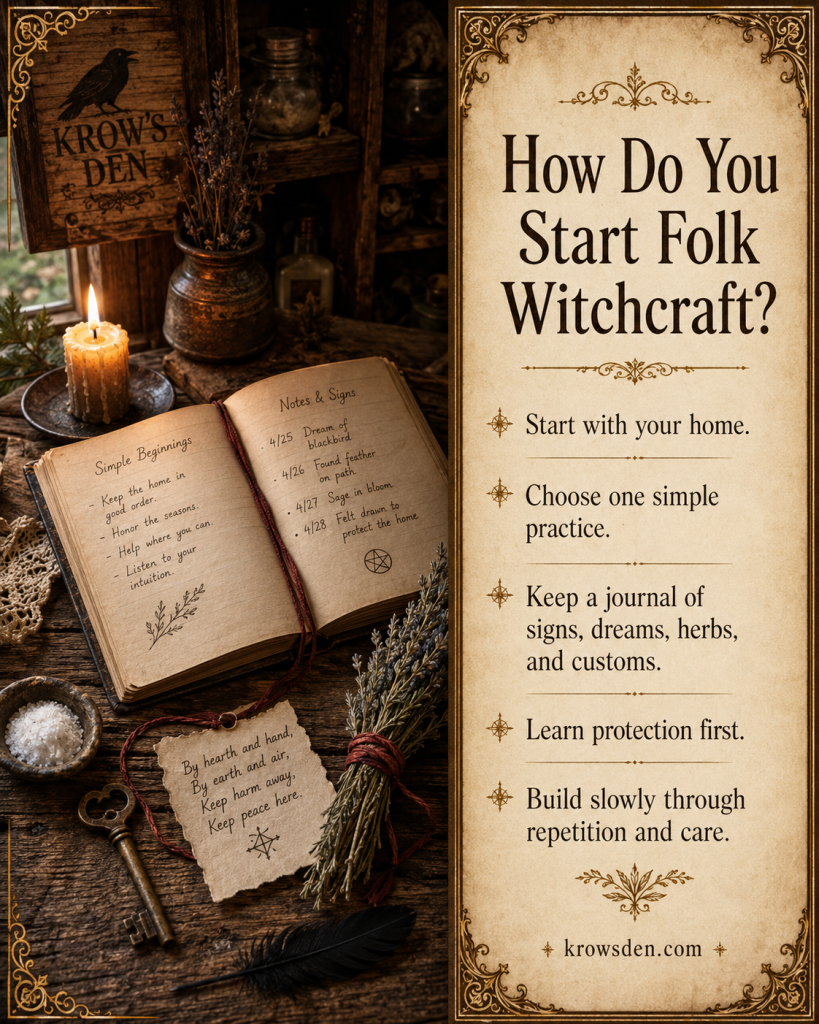
A beginner folk witch notebook with one candle, one herb bundle, one key, salt, and a simple written charm.
Start folk witchcraft with your home.
Choose one simple practice that supports daily life.
Light a candle with intention,
Sweep your doorway mindfully,
Keep a small bowl of salt near your workspace,
Make a protective charm bag,
Begin a herb notebook,
Write a simple blessing for your room.
Learn your local plants, seasons, weather patterns, birds, and natural signs.
Keep a journal of repeated symbols, dreams, family sayings, old recipes, protective habits, and folklore that interests you.
Choose one area to study first.
Protection is a strong beginner focus.
Herbs are another good starting point.
Divination, charm work, household magick, and seasonal rituals can come later.
Folk witchcraft grows through repetition.
Small practices done with care are often stronger than dramatic rituals done once and forgotten.
Continue exploring: Your Journey
Is Folk Witchcraft Safe?

A practical safety table with labelled herbs, candle snuffer, gloves, closed jars, pet-safe note, and grounding stone.
Folk witchcraft can be safe when practised with care, respect, and common sense.
The main risks come from unsafe herbs, fire hazards, smoke exposure, cultural appropriation, fear-based thinking, poor research, and replacing real-world support with magical thinking.
Use candles safely.
Do not leave flames unattended.
Research herbs before using them in tea, smoke, baths, oils, or food.
Be careful with essential oils around pets, children, pregnancy, asthma, and sensitive skin.
Do not ingest wild plants unless they have been identified beyond doubt by a qualified source.
Do not use folk witchcraft as a replacement for medical, mental health, legal, financial, or emergency help.
Safe folk witchcraft is grounded.
It protects life, respects culture, checks sources, and knows when practical action is needed.
Continue exploring: Herbal Medicine Recipes
What Are Common Misconceptions About Folk Witchcraft?
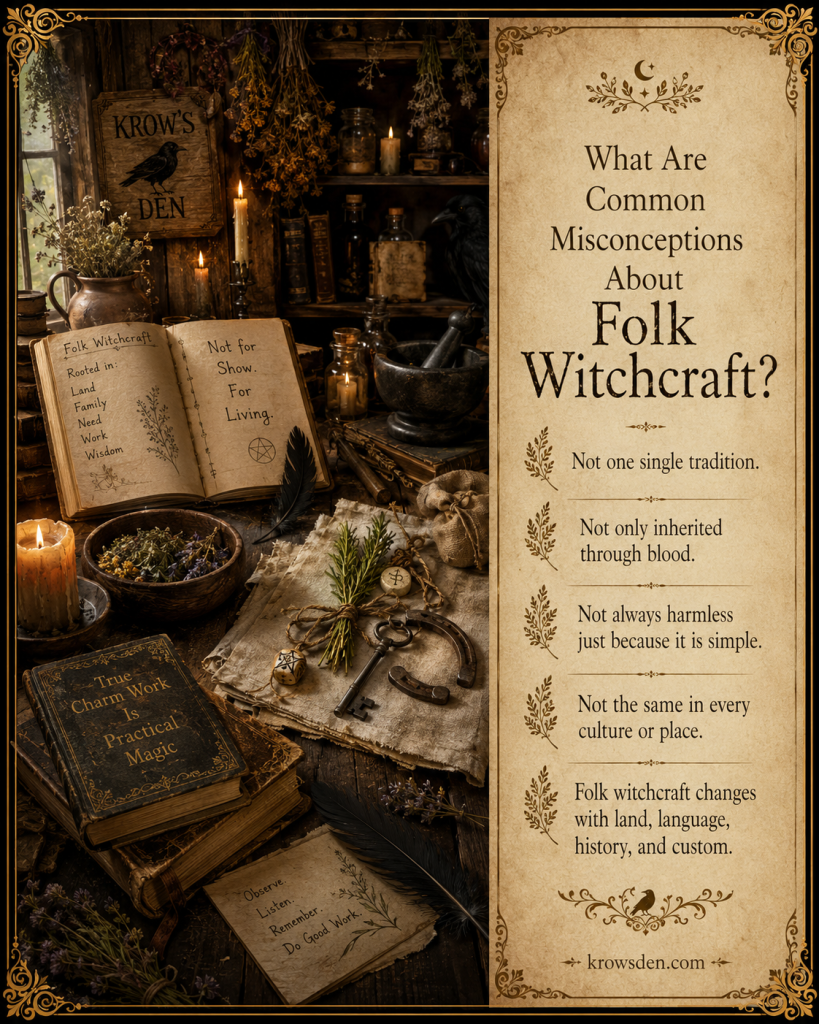
A realistic myth-versus-reality folk-magick scene with old superstition imagery on one side and grounded practical charm work on the other.
One common misconception is that folk witchcraft is only old-fashioned superstition.
In reality, it is a broad category of practical magical customs, protective beliefs, healing lore, seasonal observances, divination methods, and household traditions.
Another misconception is that folk witchcraft must be inherited through blood.
Heritage can be meaningful, but folk witchcraft can also be built through study, local practice, community learning, and respectful relationship with place.
Some people think folk witchcraft is always simple and harmless.
Simple does not mean careless.
Herbs, smoke, fire, sharp objects, cultural traditions, and spirit work all require respect.
Another misconception is that folk witchcraft looks the same everywhere.
It does not.
Folk witchcraft changes with language, land, culture, religion, family custom, migration, climate, plants, and history.
That variety is part of its power.
Continue exploring: What is Magick
Continue Exploring Krow’s Den
Folk witchcraft connects naturally with witchcraft traditions, magick, correspondences, herbs, crystals, divination, protection, sacred paths, astrology, lunar magick, planetary timing, and personal spiritual development.
Continue exploring:
- Astrology
- Divination
- Correspondences —
- Downloads
- Your Journey
- What Is a Witch
- What Is Magick
- Herbal Medicine
- Latest Blog Posts
- About Krow’s Den
- Contact Krow’s Den
Helpful Sources
- English Heritage: A Journey into Witchcraft Beliefs
https://www.english-heritage.org.uk/learn/histories/journey-into-witchcraft-beliefs/ - English Heritage: Historical Ways to Protect Against Evil Spirits
https://www.english-heritage.org.uk/visit/inspire-me/historical-ways-to-protect-against-evil-spirits/ - English Heritage: Witchcraft Myths and Misconceptions
https://www.english-heritage.org.uk/learn/histories/eight-witchcraft-myths/ - Museum of Witchcraft and Magic
https://museumofwitchcraftandmagic.co.uk/ - The National Archives: Early Modern Witch Trials
https://www.nationalarchives.gov.uk/education/resources/early-modern-witch-trials/