
A birth chart is much more than a collection of planets scattered throughout the zodiac.
While zodiac signs, planets, and houses each provide important information, astrologers also examine the relationships between those planets. These relationships are known as planetary aspects.
Planetary aspects describe the angular distances between celestial bodies within a birth chart. These angles are believed to influence how different energies interact, cooperate, challenge one another, or create opportunities for growth.
Some aspects are traditionally considered harmonious, while others are viewed as challenging. Together, they create the unique patterns that make every birth chart different.
Understanding aspects is one of the most important steps in moving beyond basic astrology and into deeper chart interpretation.
What Are Planetary Aspects?
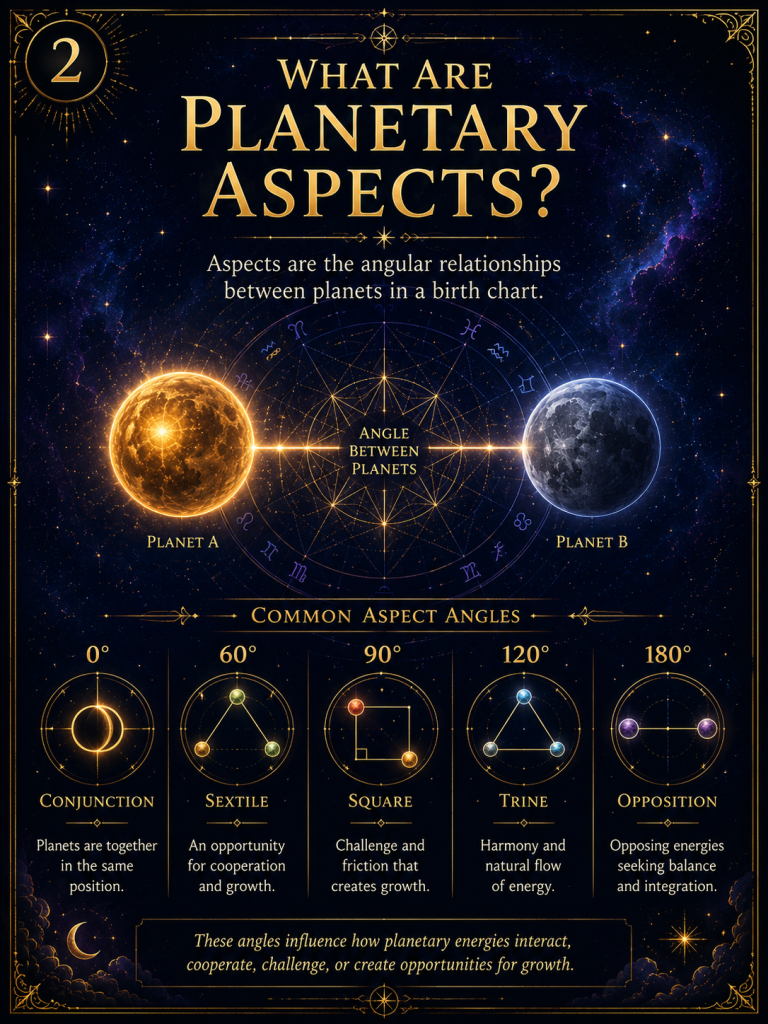
Planetary aspects are the geometric relationships formed between planets within a birth chart.
When astrologers calculate a chart, they examine the angular distance separating each planet.
For example:
- Two planets may be close together.
- Two planets may be directly opposite one another.
- Two planets may form a ninety-degree angle.
Each angle creates a different type of aspect and is interpreted differently.
These relationships help astrologers understand how various parts of a person’s personality and life experiences may interact.
Why Are Aspects Important?
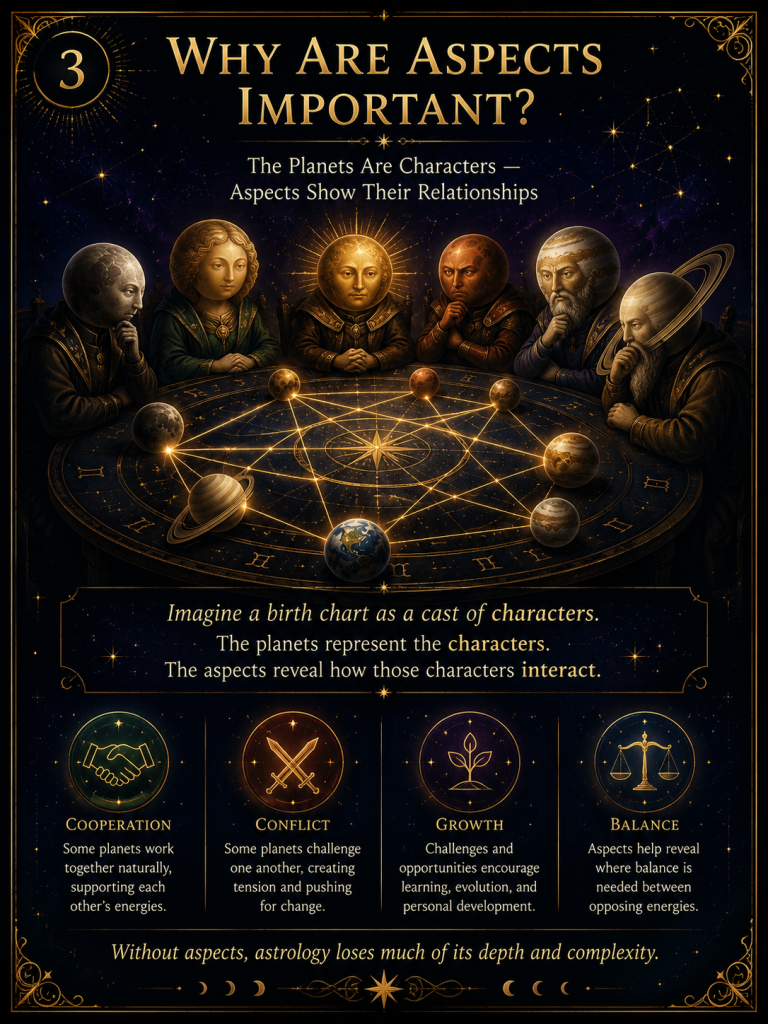
Imagine a birth chart as a cast of characters.
The planets represent the characters themselves.
The aspects reveal how those characters interact.
Some may work together naturally.
Some may challenge one another.
Others may create tension that encourages growth and development.
Without aspects, astrology loses much of its depth and complexity.
The Major Planetary Aspects
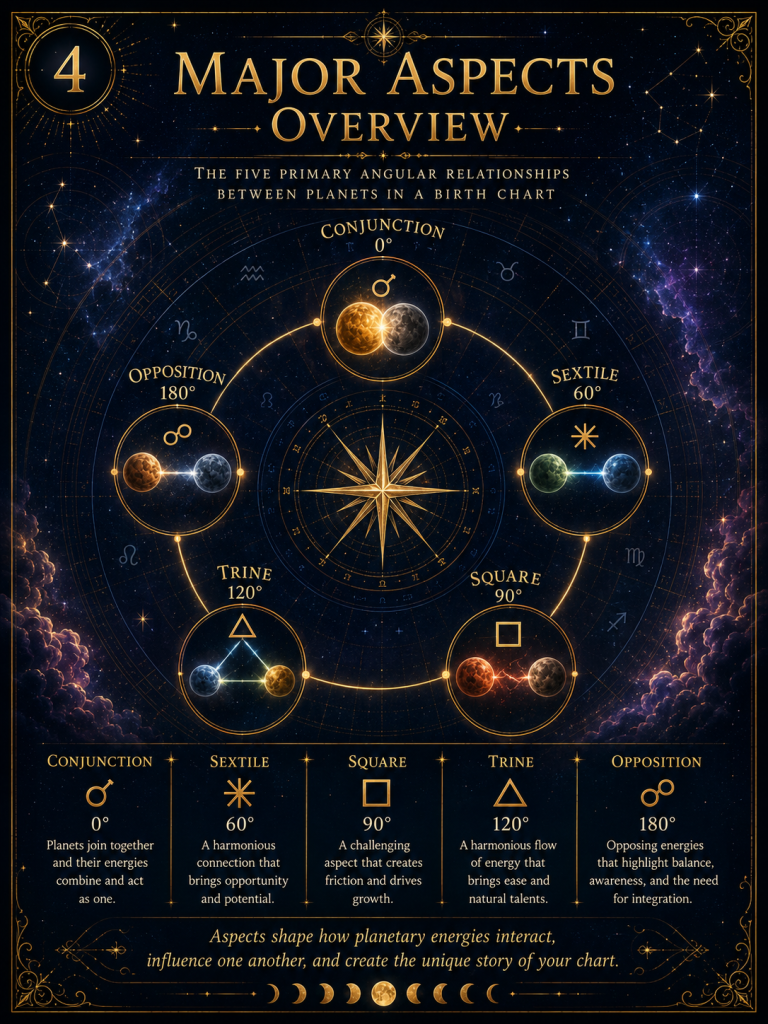
Most astrological traditions focus on several primary aspects.
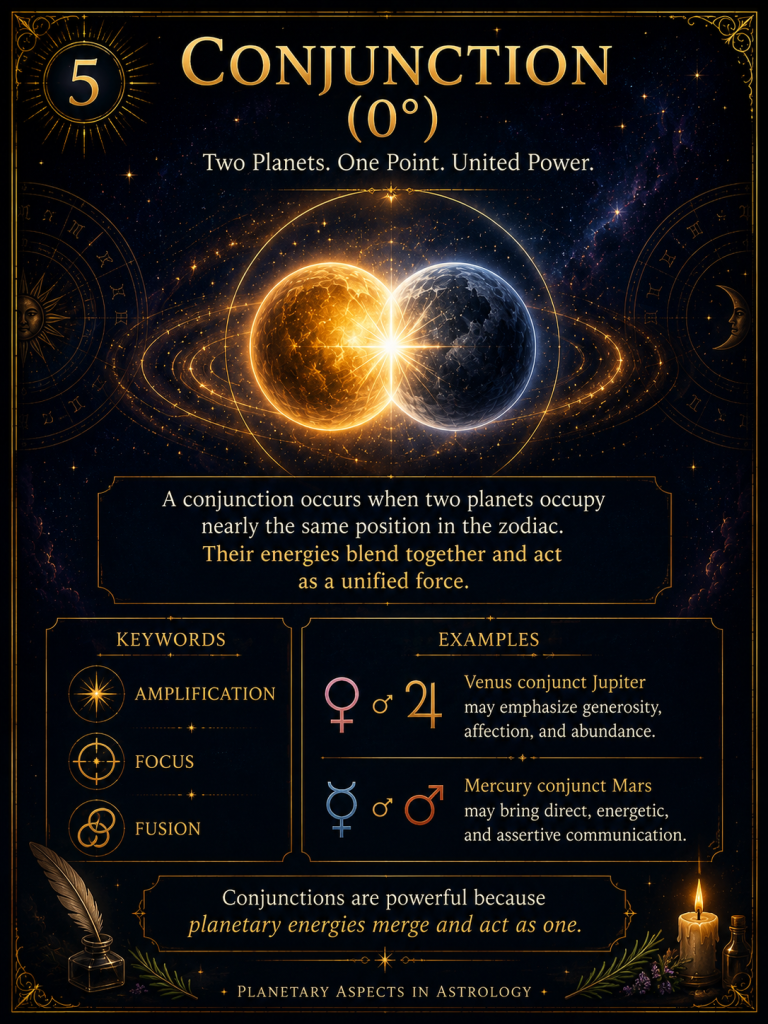
Conjunction (0°)
Keywords
- Amplification
- Focus
- Fusion
A conjunction occurs when two planets occupy nearly the same position in the zodiac.
Their energies become closely linked and often work together as a unified force.
For example:
- Venus conjunct Jupiter may emphasize generosity and affection.
- Mercury conjunct Mars may create direct and energetic communication.
Conjunctions are often powerful because they blend planetary energies together.
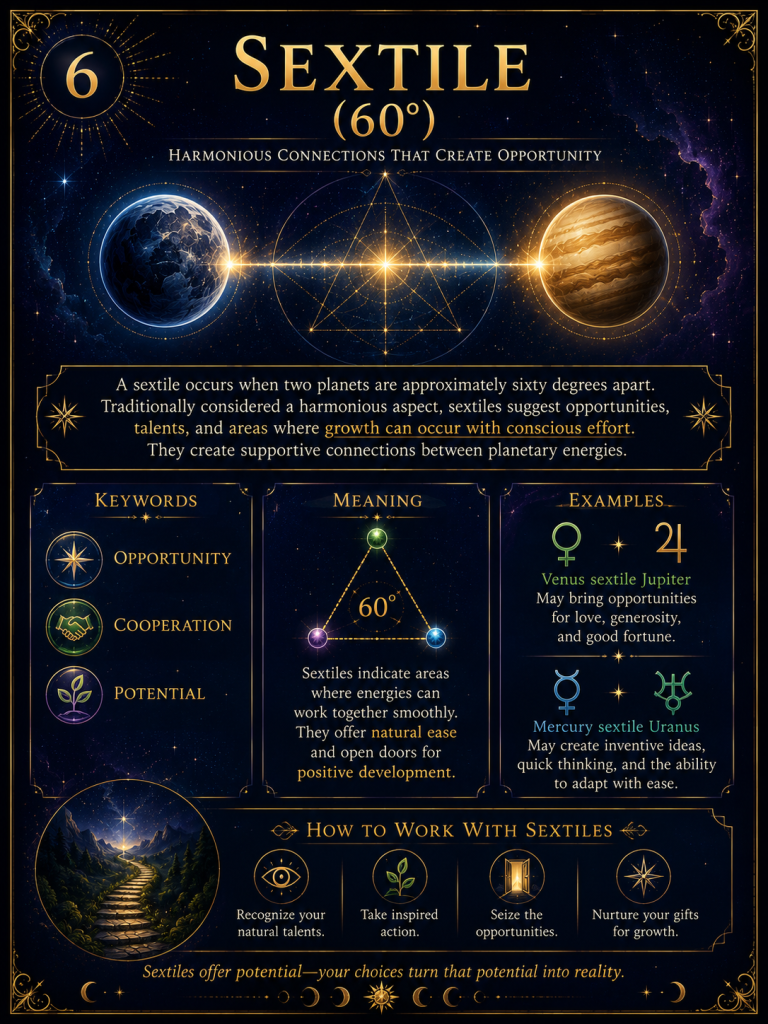
Sextile (60°)
Keywords
- Opportunity
- Cooperation
- Potential
A sextile occurs when planets are approximately sixty degrees apart.
Traditionally considered a harmonious aspect, the sextile often suggests opportunities, talents, and areas where growth can occur with conscious effort.
Sextiles tend to create supportive connections between planetary energies.
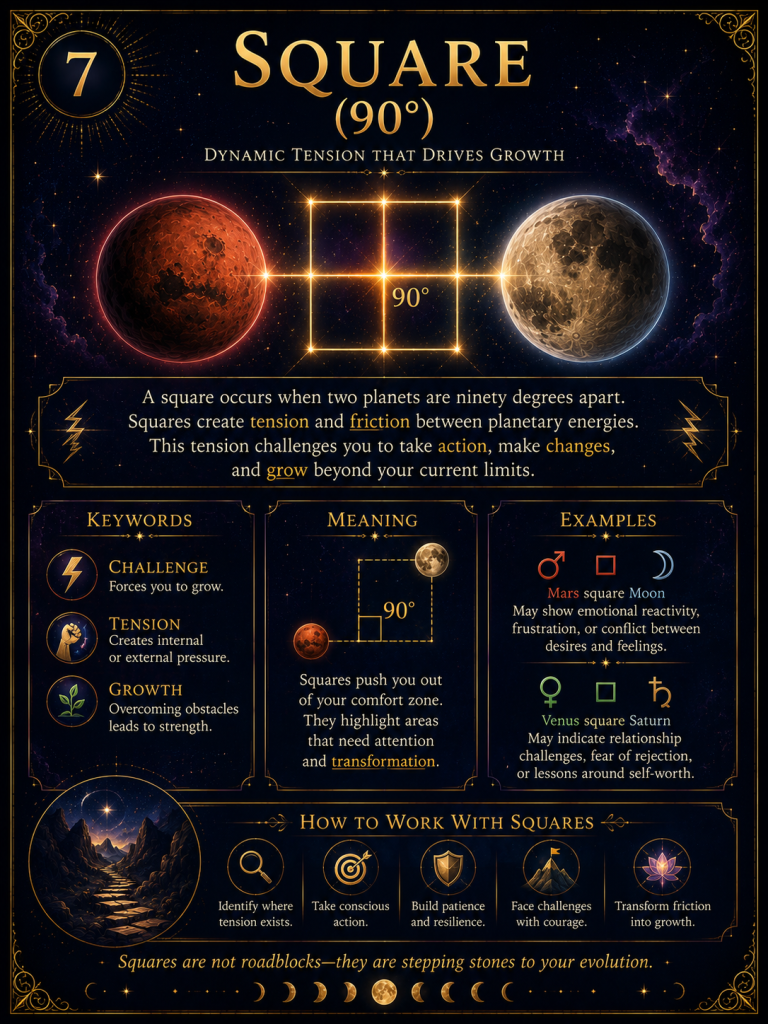
Square (90°)
Keywords
- Challenge
- Conflict
- Growth
A square occurs when planets are approximately ninety degrees apart.
Squares are often considered challenging aspects because they create friction between planetary energies.
However, this friction frequently becomes a source of motivation and personal development.
Many astrologers view squares as some of the most powerful catalysts for growth.
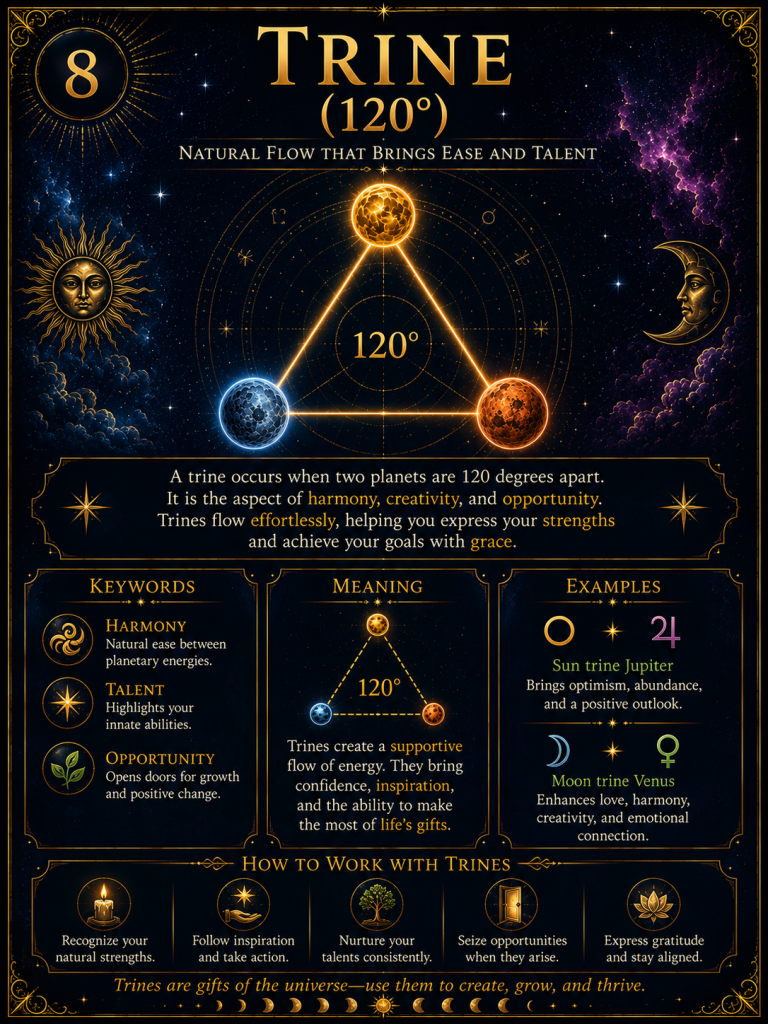
Trine (120°)
Keywords
- Harmony
- Ease
- Natural Flow
A trine occurs when planets are approximately one hundred and twenty degrees apart.
Traditionally viewed as one of astrology’s most harmonious aspects, trines often indicate talents, strengths, and areas where energy flows naturally.
While generally positive, some astrologers caution that trines can occasionally encourage complacency if their gifts are taken for granted.
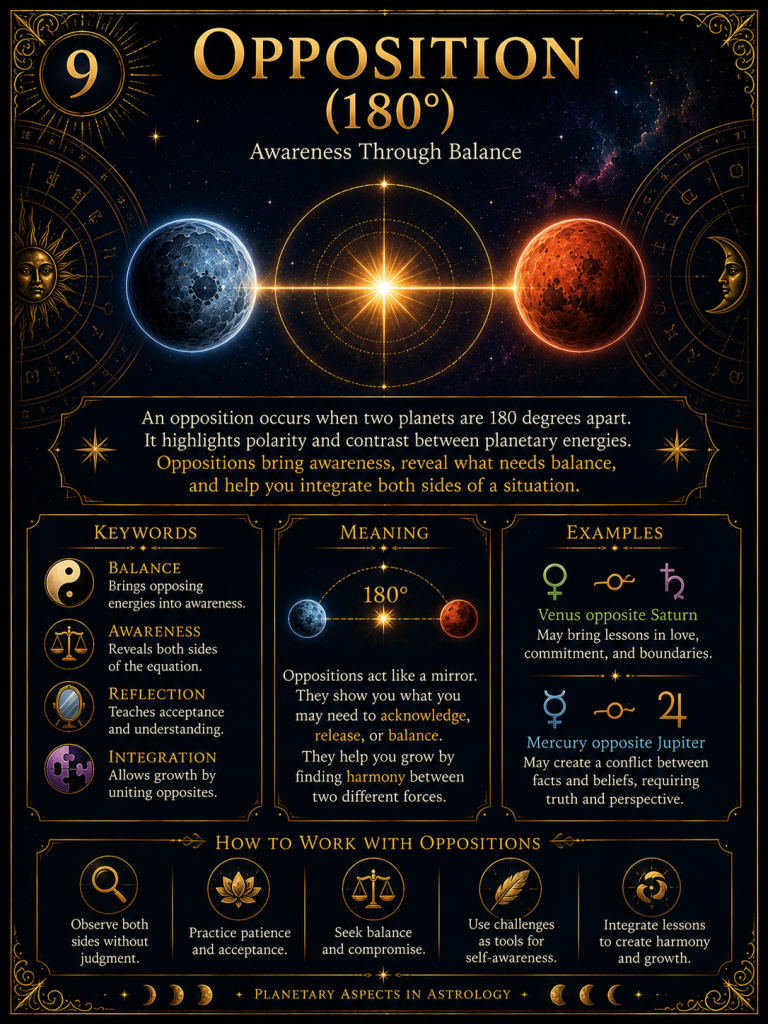
Opposition (180°)
Keywords
- Balance
- Awareness
- Polarity
An opposition occurs when planets are directly opposite one another.
This aspect often highlights tension between competing needs, perspectives, or life themes.
Oppositions encourage awareness, balance, and integration.
Although challenging at times, they often provide valuable opportunities for growth and self-understanding.
Minor Aspects
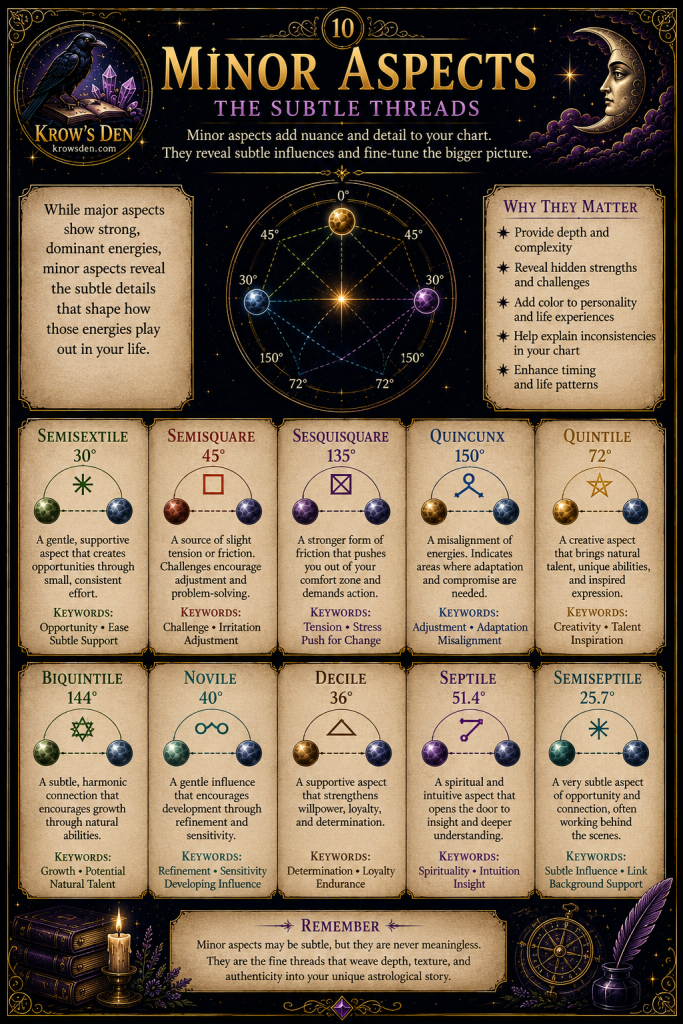
In addition to the major aspects, many astrologers work with smaller or more specialized aspects.
These may include:
- Semi-Sextile (30°)
- Semi-Square (45°)
- Sesquiquadrate (135°)
- Quincunx (150°)
- Quintile (72°)
Different astrological traditions place varying levels of importance on these aspects.
Aspect Patterns
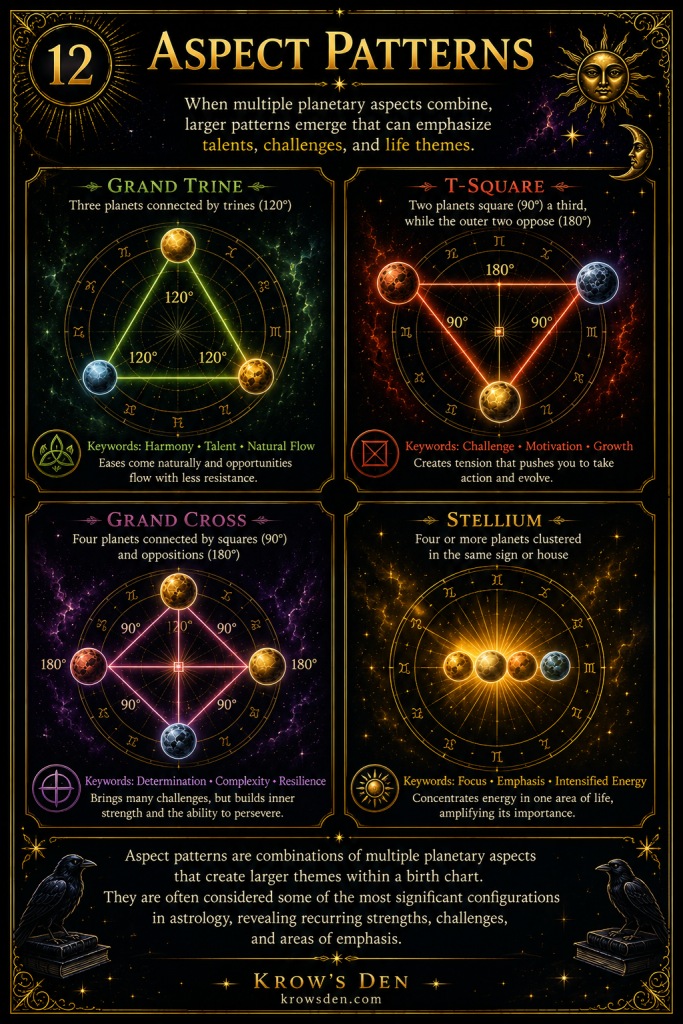
When multiple aspects connect several planets, larger patterns can emerge.
These patterns are often considered particularly significant.
Examples include:
Grand Trine
Three planets connected through trines.
Often associated with natural talents and harmonious energy flow.
T-Square
Two squares connected through an opposition.
Often associated with challenges that drive personal growth.
Grand Cross
Four planets connected through multiple squares and oppositions.
Often associated with complexity, determination, and significant life lessons.
Stellium
A concentration of several planets within one sign or area of the chart.
Often creates a strong emphasis on specific themes.
Aspects and Personality
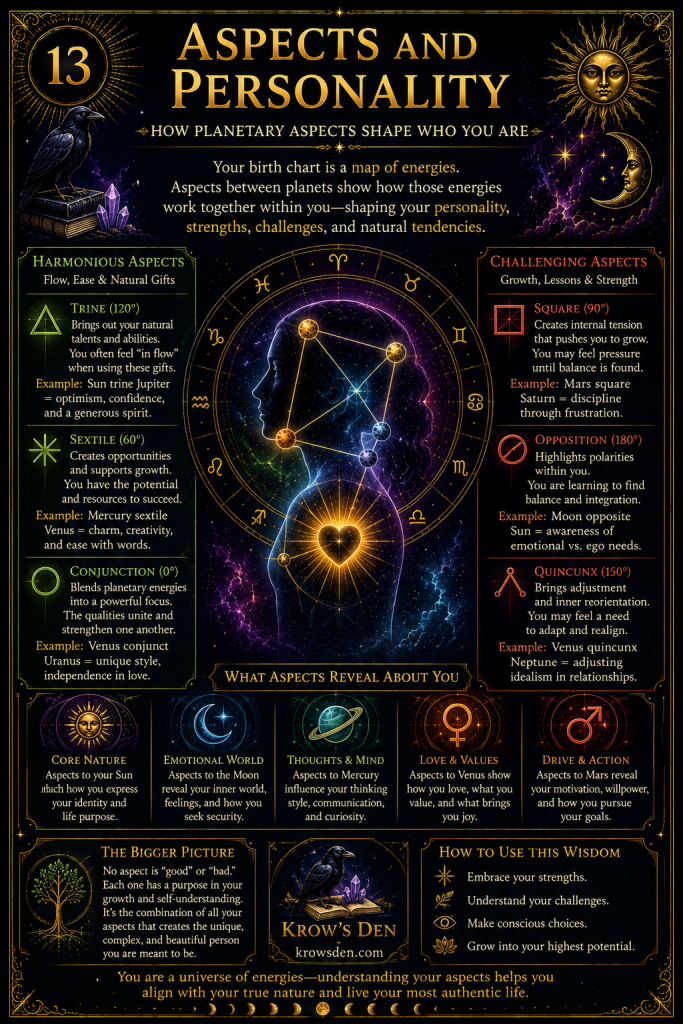
Planetary aspects help explain why two people with similar planetary placements can have very different personalities.
For example:
Two people may both have:
- Sun in Leo
- Moon in Taurus
Yet their charts may contain completely different aspects.
These aspect patterns influence how planetary energies cooperate or conflict, creating unique individual experiences.
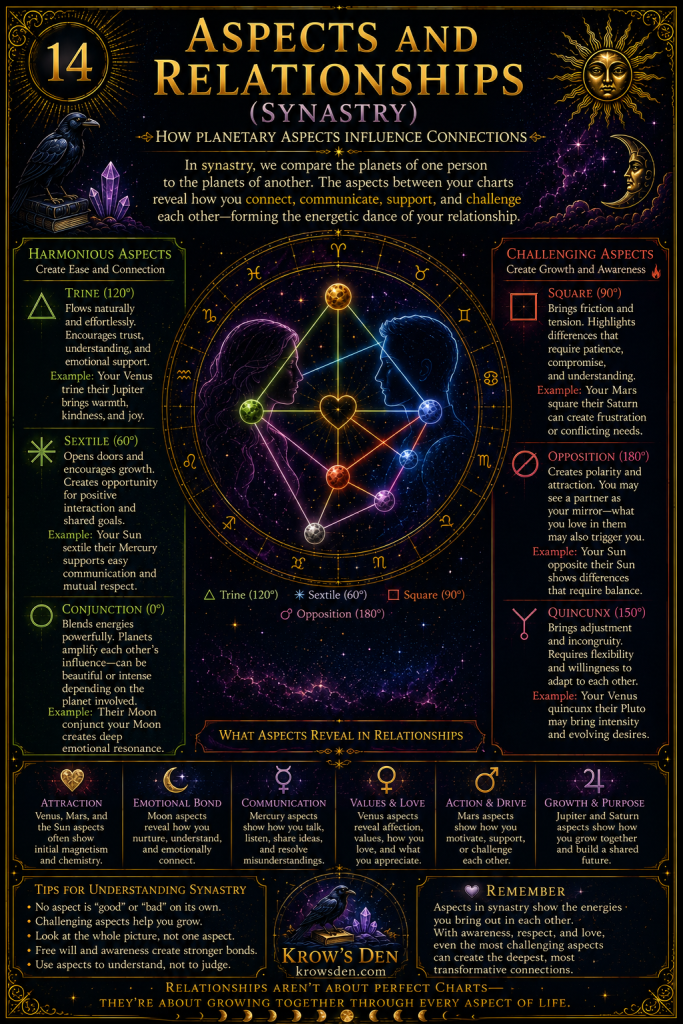
Aspects and Relationships
Many astrologers also examine aspects between the charts of two people.
This practice is known as synastry.
Relationship aspects may reveal:
- Communication styles
- Emotional compatibility
- Shared strengths
- Potential challenges
Although compatibility involves many factors, aspects often play an important role in relationship analysis.
Aspects and Growth
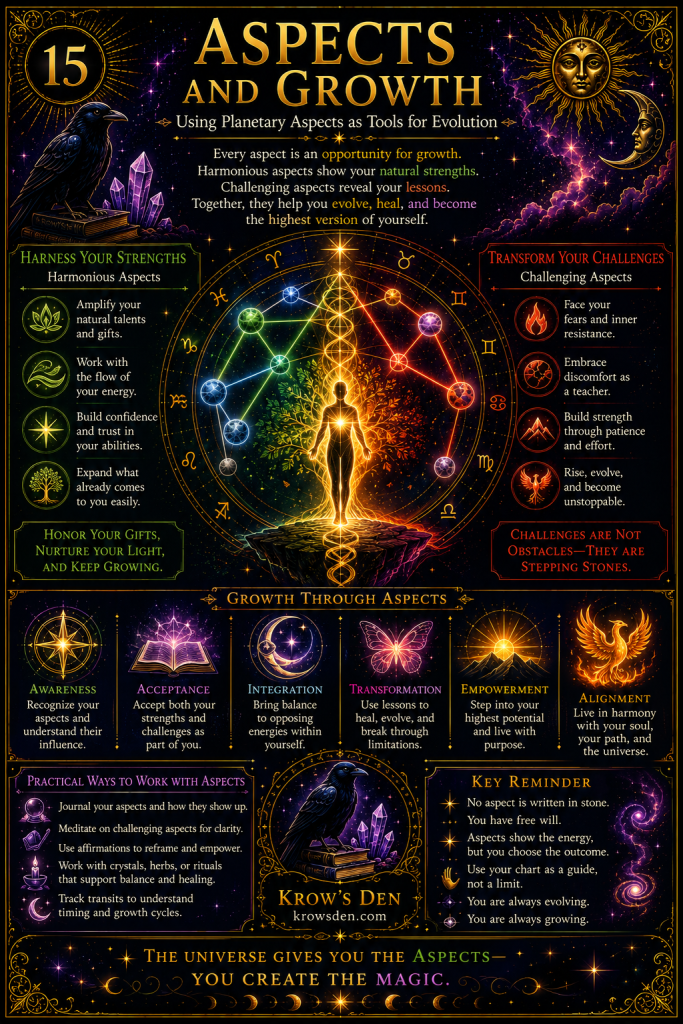
One reason astrologers value aspects so highly is that they often reveal opportunities for growth.
Harmonious aspects may indicate natural talents.
Challenging aspects may indicate areas where effort, awareness, and personal development are needed.
Neither is inherently good or bad.
Many astrologers believe that difficult aspects often produce some of the greatest lessons and achievements.
Common Misconceptions About Aspects
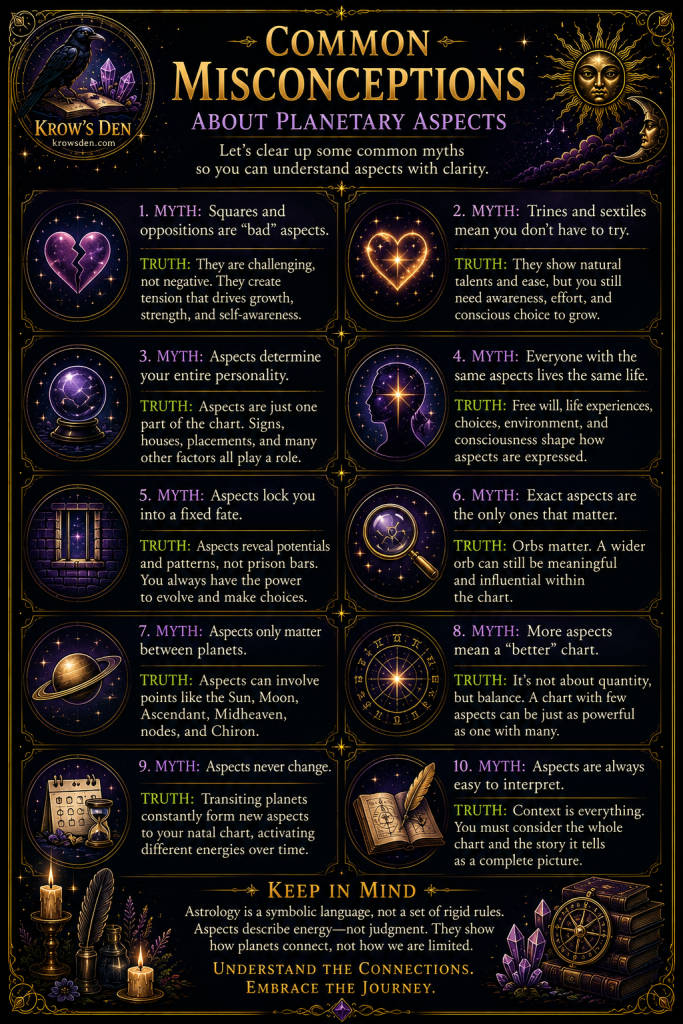
Myth: Squares Are Bad
Squares often create growth, motivation, and resilience.
Myth: Trines Are Always Positive
Trines can sometimes encourage complacency if their strengths are not developed.
Myth: One Aspect Defines a Person
Astrologers examine the entire chart rather than focusing on a single aspect.
Myth: Oppositions Are Negative
Oppositions often teach balance and self-awareness.
Why Study Planetary Aspects?
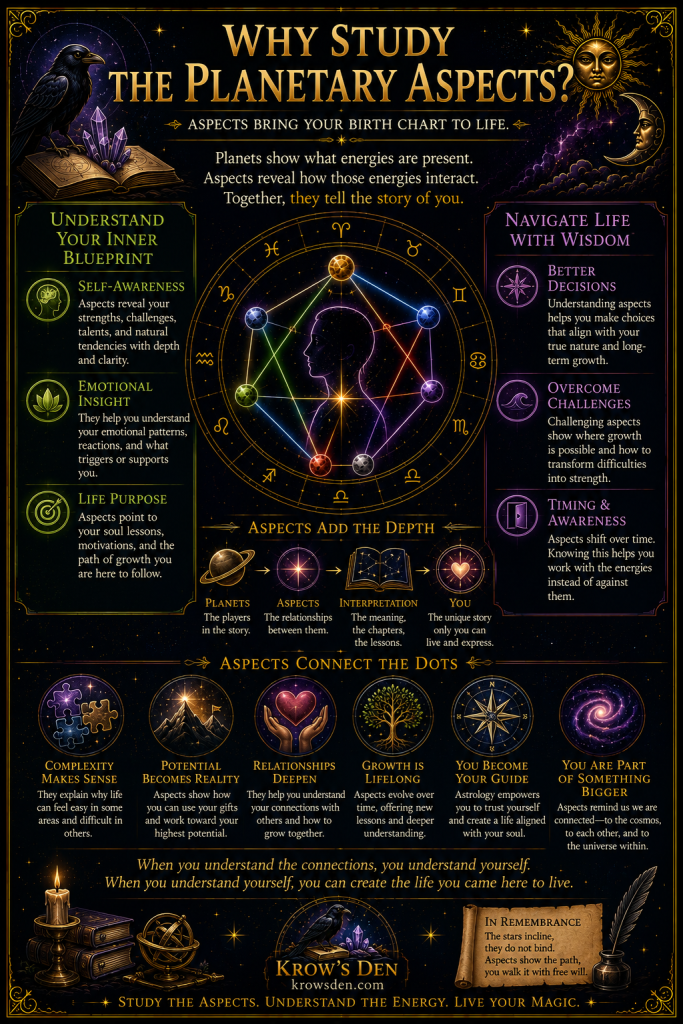
Planetary aspects are one of the most important tools in chart interpretation.
They reveal:
- How planetary energies interact
- Areas of harmony
- Sources of challenge
- Opportunities for growth
- Unique personality patterns
Without aspects, a birth chart is incomplete.
Understanding them allows astrologers to move beyond simple placements and begin exploring the deeper relationships that make every chart unique.
Where to Go Next
Continue exploring the Astrology Learning Center:
- Birth Charts
- The Planets
- The Houses
- Zodiac Signs
- Sun Signs
- Moon Signs
- Rising Signs
- The Four Elements
- Modalities
- Astrology and Magick
Recommended Resources
📚 Encyclopaedia Britannica – Astrology
https://www.britannica.com/topic/astrology