Discovering the History, Symbolism, and Traditions of Crystal Magic
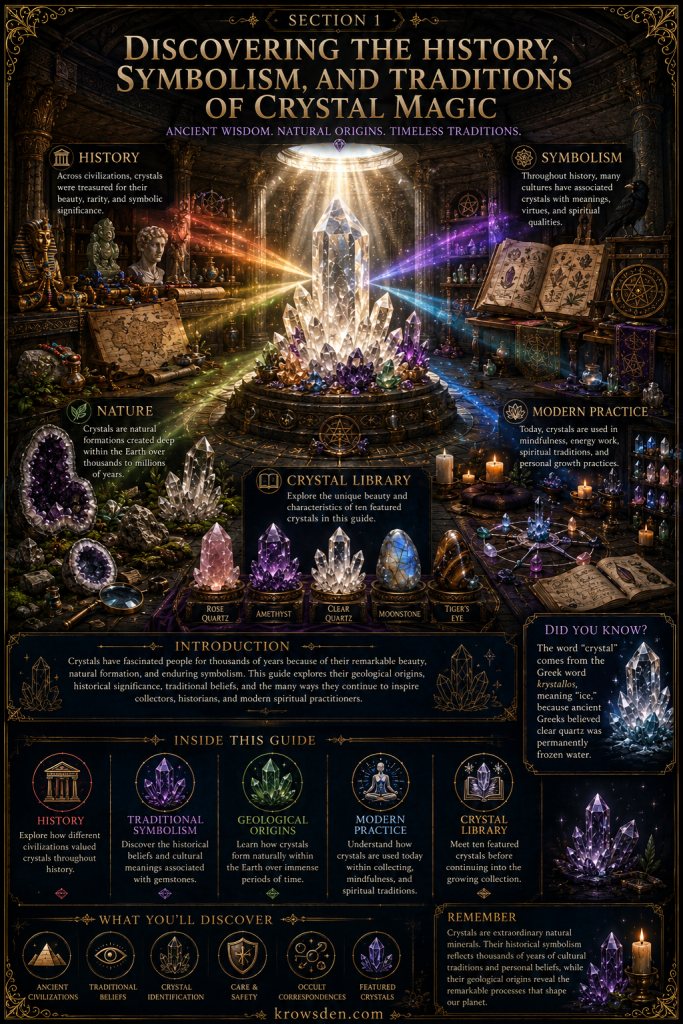
For thousands of years, crystals have captivated humanity with their remarkable beauty, vibrant colours, and extraordinary natural formations. Long before modern science revealed how minerals develop deep within the Earth over immense periods of time, people looked upon crystals with a sense of wonder and mystery. Their transparency, symmetry, and dazzling colours inspired countless stories, traditions, and spiritual beliefs that continue to influence cultures around the world today.
Throughout history, crystals have been admired not only as beautiful natural treasures but also as meaningful symbols. Ancient civilisations carved them into jewellery, fashioned them into protective amulets, placed them in temples, and buried them alongside rulers and loved ones. Different societies believed certain stones represented wisdom, courage, prosperity, protection, healing, or a connection with divine forces. Although these meanings varied greatly between cultures, one idea remained remarkably consistent: crystals were considered special gifts from the Earth that deserved respect and admiration.
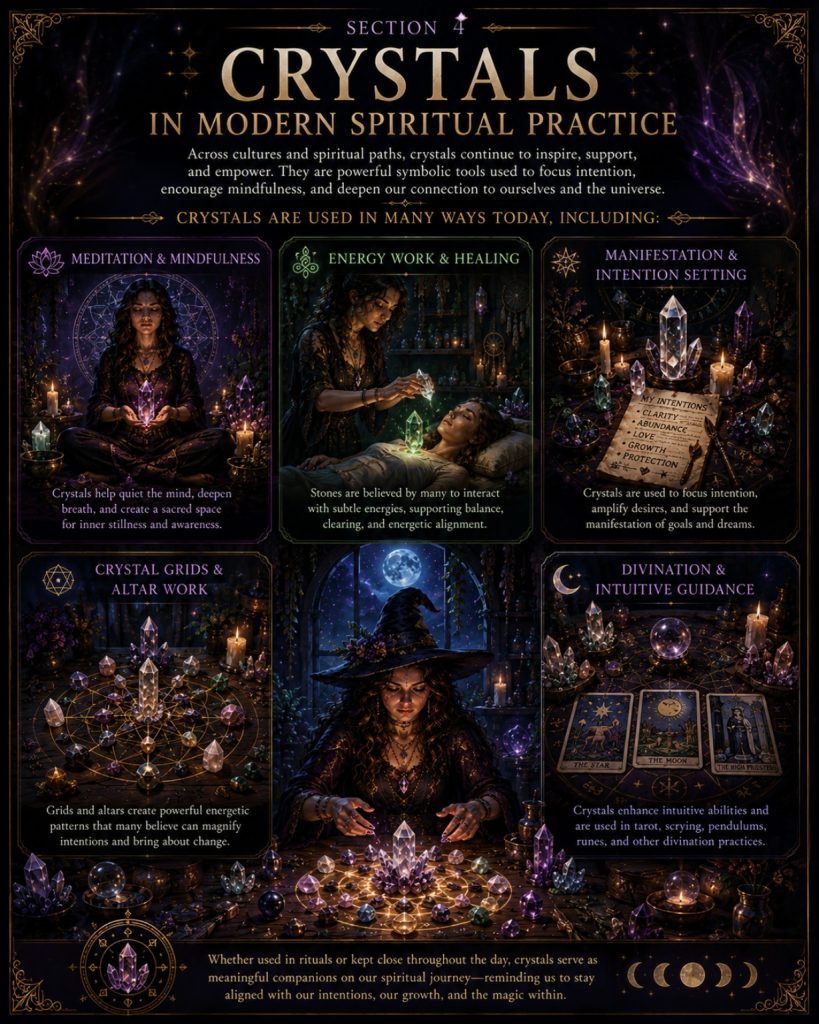
Today, crystals continue to play an important role in many modern spiritual and magical traditions. Some practitioners incorporate them into meditation, altar work, manifestation, ritual, divination, crystal grids, and energy-focused practices. Others simply appreciate crystals for their geological beauty, historical significance, or symbolic meaning. Many people also enjoy collecting minerals as fascinating examples of the incredible processes that shape our planet.
Crystals in the Modern World
It is important to recognise that the spiritual meanings commonly associated with crystals come from historical traditions, folklore, cultural beliefs, and personal experience rather than established scientific evidence. Scientific research has revealed the remarkable geological processes responsible for crystal formation and the unique physical properties of different minerals, while metaphysical interpretations remain matters of individual belief and cultural tradition.
For many people, the value of crystals lies not in proving supernatural abilities but in their ability to encourage mindfulness, focus intention, inspire reflection, and create meaningful rituals. Whether someone approaches crystals from a scientific, historical, artistic, or spiritual perspective, they continue to offer a fascinating connection between humanity and the natural world.
This guide explores crystals through the lens of history, folklore, symbolism, and traditional magical practice. Together, we’ll discover how different cultures understood these remarkable minerals, how crystal symbolism developed over thousands of years, and why crystals continue to inspire curiosity and spiritual exploration today.
Traditional Beliefs About Crystals
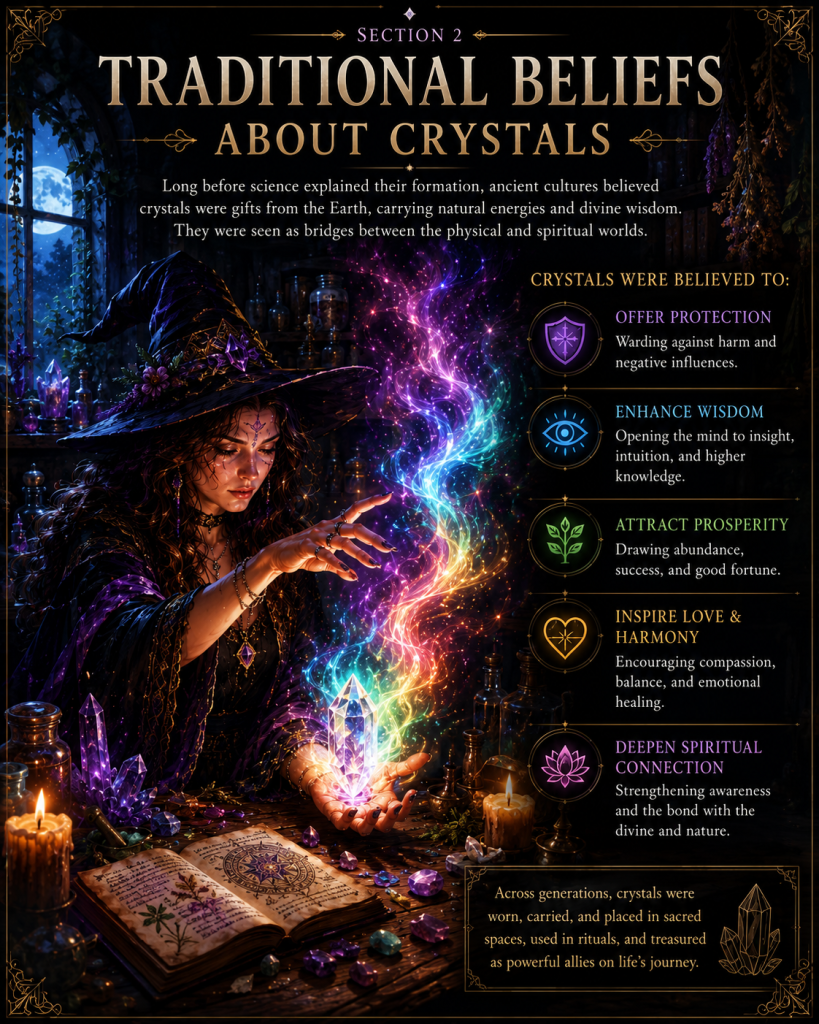
Long before modern geology explained how crystals formed, many ancient cultures regarded them as extraordinary gifts from the Earth. Their remarkable colours, perfect geometric shapes, and ability to reflect and refract light inspired countless legends, spiritual traditions, and magical beliefs. Unlike ordinary stones, crystals appeared almost otherworldly, leading many people to believe they possessed unique qualities or acted as bridges between the physical and spiritual worlds.
Many early societies believed crystals embodied the life force of nature itself. Formed deep beneath the Earth’s surface over immense periods of time, they came to symbolise endurance, transformation, hidden wisdom, and the enduring power of the natural world. Although every culture interpreted these stones differently, many shared the belief that crystals represented harmony, balance, and the unseen forces that governed life.
Throughout history, crystals were often viewed as sacred objects rather than simple minerals. Many traditions believed they carried the strength of mountains, the wisdom of the Earth, or the blessings of divine beings. Their seemingly flawless structures and vibrant colours inspired the belief that they were created with purpose rather than by chance.
Crystals as Symbols of Protection and Wisdom
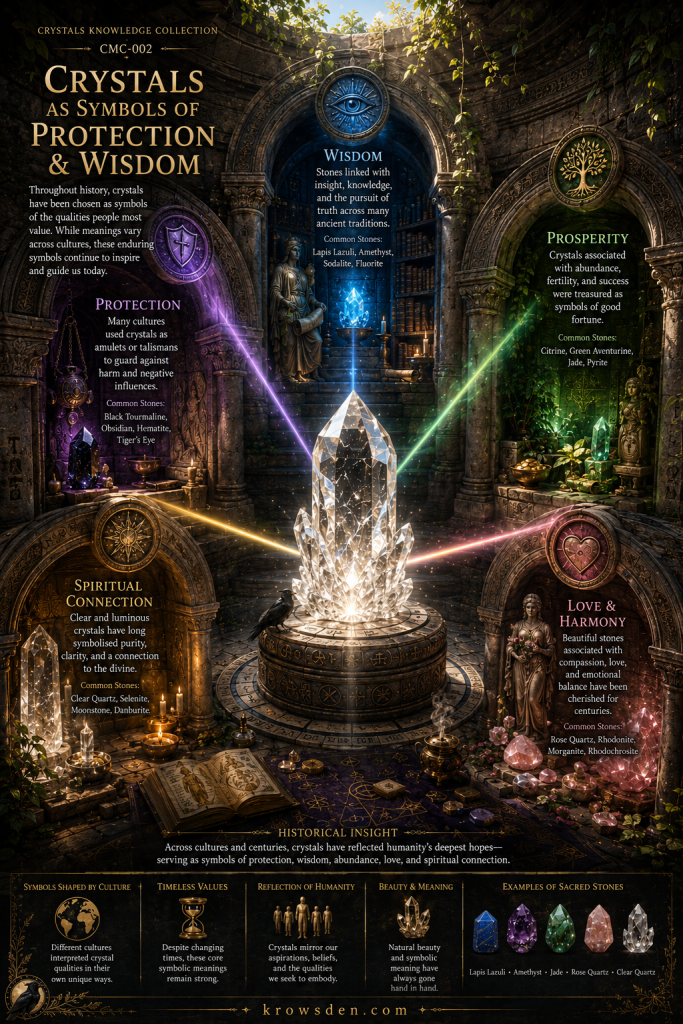
Protective charms made from crystal and stone have been discovered in archaeological sites across many parts of the world. Ancient people wore gemstones as jewellery, carried polished stones in pouches, placed them within homes, and incorporated them into ceremonial clothing. While the meanings varied between cultures, these objects were often believed to attract favourable influences or offer symbolic protection against misfortune.
Different stones gradually became associated with particular qualities. Clear stones were commonly linked with clarity and purity, green stones with growth and prosperity, red stones with vitality and courage, black stones with protection and grounding, and blue stones with wisdom or communication. Many of these symbolic associations continue to influence modern crystal traditions today.
Crystals were not reserved only for priests, rulers, or ceremonial leaders. Historical evidence shows that many cultures incorporated stones into everyday life as jewellery, decorative objects, household charms, burial goods, religious offerings, and treasured family possessions. Their beauty alone made them highly valued, while their symbolic meanings often gave them even greater importance.
Today, many modern spiritual practitioners continue these traditions in new ways. Crystals are commonly placed on altars, used during meditation, arranged into crystal grids, carried as personal reminders of intention, or displayed simply because they inspire peace, beauty, and reflection. Although modern beliefs differ widely and remain matters of personal faith rather than scientific consensus, the enduring symbolism of crystals continues to connect people with thousands of years of history, folklore, and cultural tradition.
A Brief History of Crystal Magic
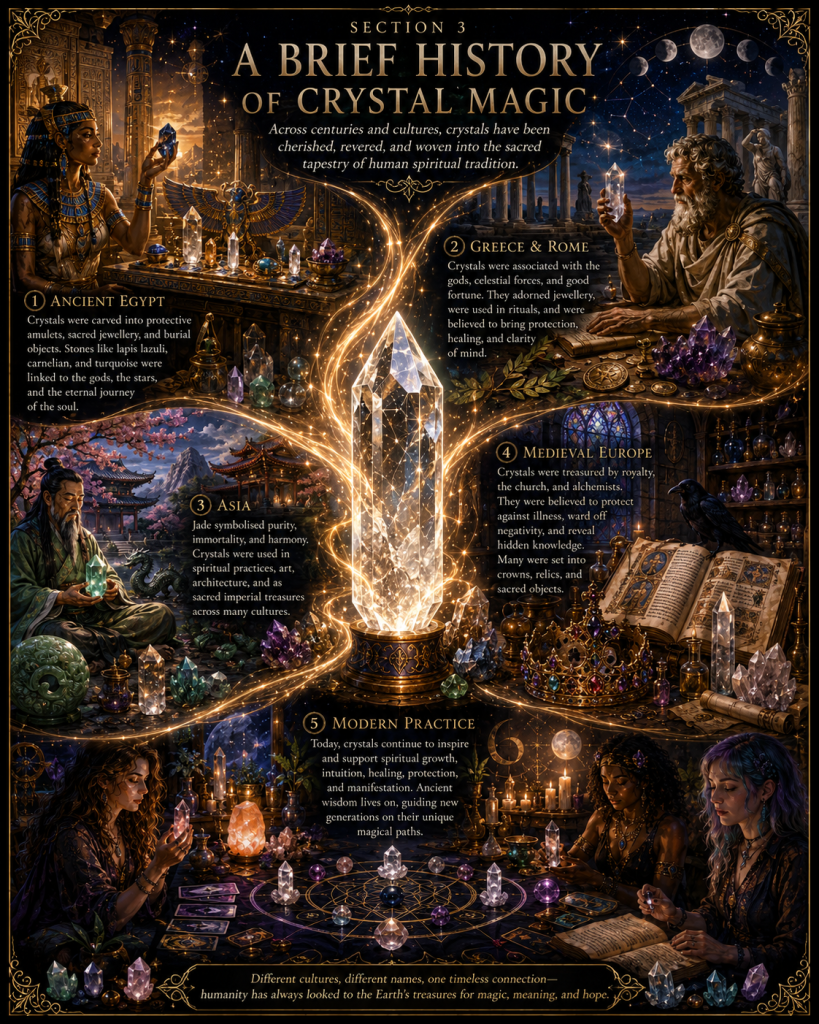
The use of crystals and gemstones stretches back thousands of years, appearing in ancient jewellery, religious objects, burial traditions, royal treasures, healing customs, and magical folklore. Long before crystals became common in modern spiritual shops and home altars, they were valued by cultures across the world for their beauty, rarity, durability, and symbolic meaning.
Ancient people did not understand minerals in the same way modern geology does today. Instead, they often interpreted crystals through mythology, religion, medicine, astrology, and magic. A stone’s colour, shine, hardness, or origin could influence the powers people believed it possessed. Over time, these beliefs became part of larger systems of folklore and tradition.
As trade routes expanded, crystals travelled between regions and gathered new meanings. A stone valued in one culture for royalty might be adopted elsewhere as a symbol of wisdom, protection, or spiritual insight. This movement helped crystal lore grow into a rich web of stories, correspondences, and magical associations.
Crystals Across Ancient Civilisations
In Ancient Egypt, stones such as lapis lazuli, turquoise, carnelian, and quartz were carved into jewellery, scarabs, amulets, and burial objects. They were associated with protection, divine connection, royal power, and the journey into the afterlife. The Greeks and Romans also admired gemstones, linking them with gods, good fortune, courage, and healing traditions.
Across Asia, jade, quartz, and other treasured stones appeared in spiritual art, ceremonial objects, and cultural practices. In medieval Europe, gemstones were discussed in lapidaries, which described the believed virtues of stones and connected them with medicine, religion, astrology, and morality.
Today, many modern crystal meanings are shaped by this long history. While contemporary practices often blend older folklore with newer spiritual systems, the fascination remains the same: crystals are seen as beautiful natural objects carrying layers of memory, symbolism, and meaning from the cultures that treasured them.
Crystal Traditions Across the Ancient World
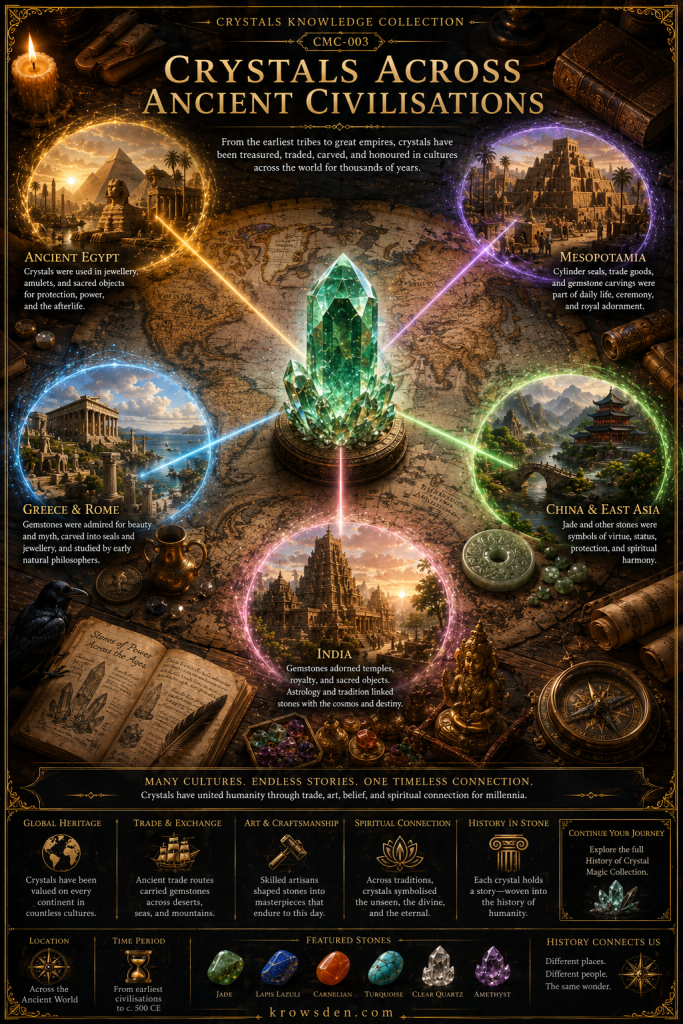
Although the ways crystals were understood differed greatly from one civilisation to another, they shared one remarkable characteristic: they were rarely viewed as ordinary stones. Across continents and throughout history, crystals and gemstones were treasured for their beauty, rarity, durability, and symbolic significance. Some were reserved for royalty, others became objects of trade, while many were incorporated into ceremonies, religious practices, jewellery, and cultural traditions that reflected the beliefs of the people who used them.
Rather than developing from a single source, crystal traditions emerged independently across many parts of the world. Ancient societies interpreted the colours, transparency, and unusual formations of minerals through the lens of their own religions, myths, philosophies, and observations of nature. These traditions evolved over thousands of years, creating the rich tapestry of crystal symbolism that continues to influence modern spiritual practice today.
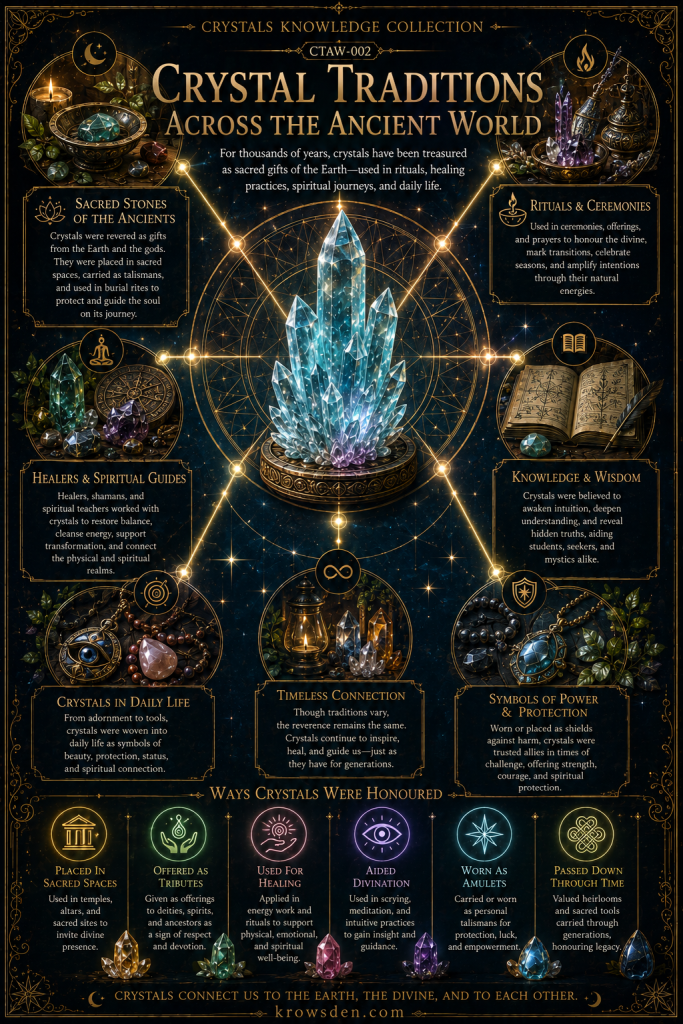
Ancient Egypt
Ancient Egypt is among the earliest civilisations known to have used crystals extensively in both daily life and religious practice. Gemstones such as lapis lazuli, carnelian, turquoise, and clear quartz were carved into jewellery, protective amulets, ceremonial objects, and burial goods. Scarabs fashioned from colourful stones symbolised rebirth and transformation, while richly decorated necklaces, rings, and crowns demonstrated both social status and spiritual belief. Crystals frequently accompanied the dead into the afterlife, reflecting the Egyptian belief that these treasured materials held symbolic importance beyond earthly life.

Greece and Rome
The ancient Greeks and Romans admired crystals for both their natural beauty and their philosophical significance. The English word crystal comes from the Greek word krystallos, meaning “ice,” because clear quartz was believed to be water permanently frozen by the gods. Gemstones were worn as jewellery, carved into seals and decorative objects, and associated with mythology, courage, wisdom, and good fortune. Roman trade networks also helped spread gemstones throughout Europe, North Africa, and the Near East, introducing new materials and traditions to distant cultures.
China and East Asia
Across China and neighbouring regions, jade became one of the most highly treasured minerals, admired not only for its beauty but also for its symbolism. It came to represent harmony, virtue, purity, and moral character, appearing in ceremonial objects, carvings, jewellery, and imperial artefacts. Quartz, agate, and other stones also featured in traditional arts and spiritual practices, where natural materials were valued for their connection to balance, craftsmanship, and the rhythms of nature.
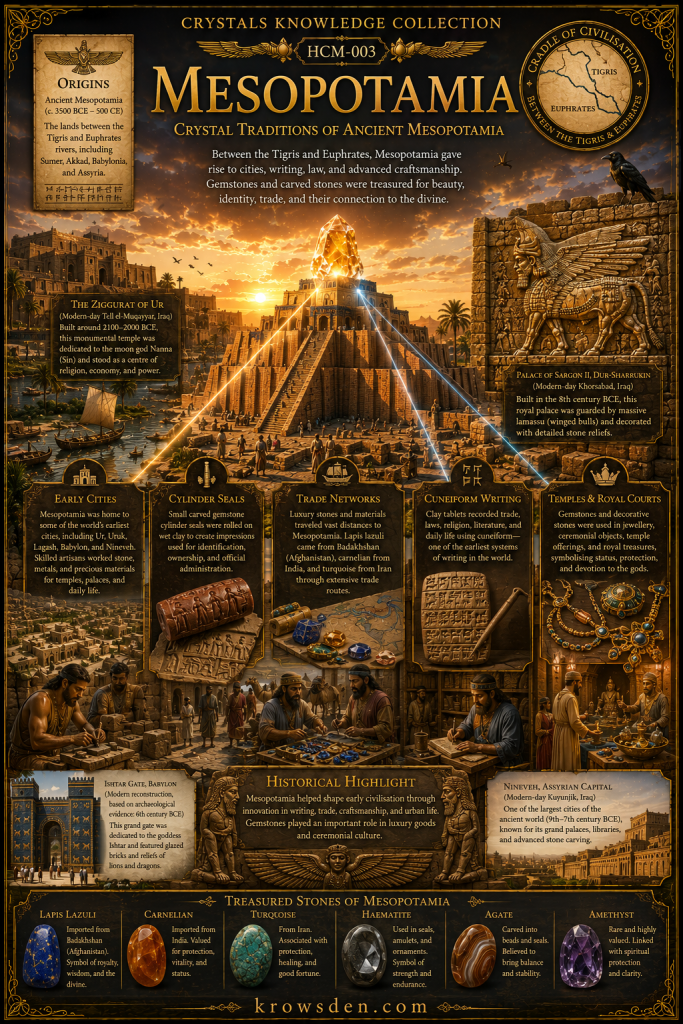
Mesopotamia
Long before the rise of Ancient Greece and Rome, the civilizations of Mesopotamia valued gemstones for their beauty, craftsmanship, and practical use. Lapis lazuli, carnelian, agate, and other stones were carved into jewellery, cylinder seals, ceremonial objects, and royal ornaments. These finely carved seals were used to identify ownership, authenticate documents, and display social status. Extensive trade networks connected Mesopotamia with neighbouring regions, allowing valuable gemstones and artistic techniques to spread throughout the ancient Near East.
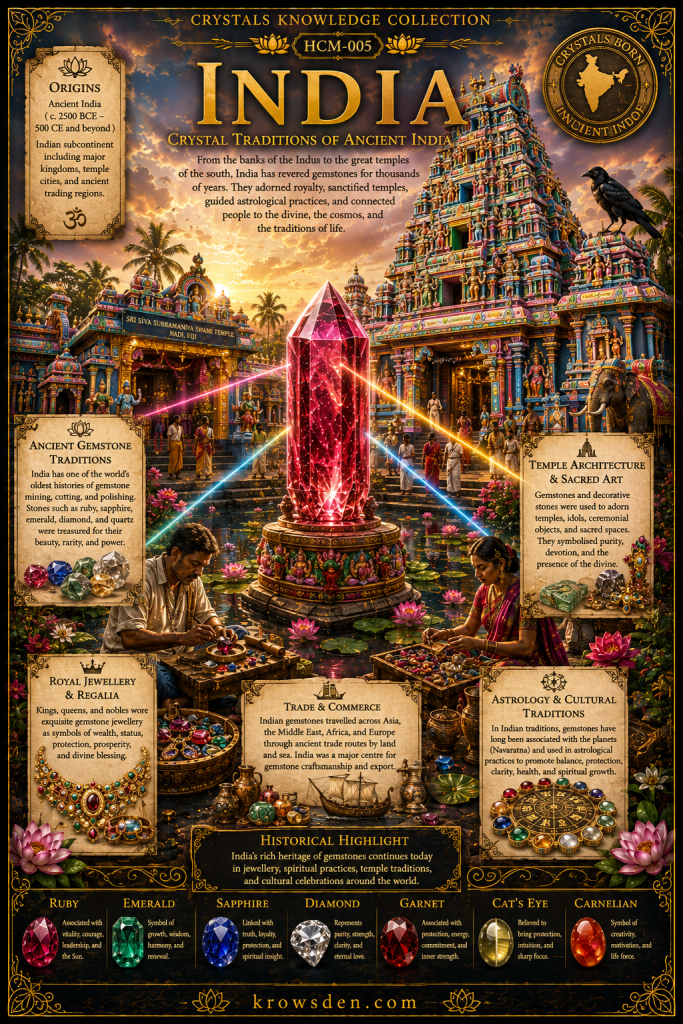
India
India has a long and well-documented history of working with gemstones. Precious stones were incorporated into jewellery, royal regalia, temple architecture, and ceremonial objects, while traditional systems of astrology associated certain gemstones with the celestial bodies. India’s gemstone trade connected the subcontinent with Asia, the Middle East, and Europe for thousands of years, helping to shape the exchange of minerals, craftsmanship, and cultural traditions that continue to influence gemstone appreciation today.
Medieval Europe and Beyond
During the Middle Ages, gemstones continued to be studied, collected, and admired throughout Europe. Scholars compiled books known as lapidaries, describing the appearance, origins, and traditional virtues associated with different stones. Crystals appeared in royal collections, religious artefacts, and works of art, while merchants introduced new minerals through expanding trade routes. Many of these historical traditions later influenced Renaissance scholars and, centuries later, helped shape aspects of modern crystal symbolism.
Today, crystal traditions draw inspiration from this rich and diverse history. Rather than belonging to a single culture or belief system, crystal lore reflects thousands of years of human curiosity, craftsmanship, spirituality, and storytelling. Modern practitioners often combine ideas from multiple traditions, appreciating crystals not only for their symbolic meanings but also for the remarkable geological history that makes each specimen a unique part of the natural world.
Choosing and Working with Crystals
Choosing a crystal is often one of the most personal aspects of crystal practice. While many traditions assign symbolic meanings to different stones, there is no single correct way to select one. Some people begin by researching the historical folklore and traditional correspondences associated with particular crystals, while others simply choose the stone that naturally catches their attention. Colour, texture, shape, symbolism, and intended purpose can all influence the decision, making the process both practical and deeply personal.
Many practitioners find that their relationship with crystals develops over time. A stone that is chosen for one purpose may later come to represent something entirely different through personal experience. For this reason, crystals often become more than decorative objects; they become reminders of important milestones, intentions, or moments of reflection. Whether displayed on a shelf, carried in a pocket, or placed on a bedside table, each crystal can develop its own unique significance for its owner.
There is also no requirement to own a large collection. Many experienced practitioners work with only a handful of favourite crystals that hold particular meaning to them. Others enjoy collecting a wide variety of minerals because of their geological beauty, historical importance, or symbolic associations. Both approaches are equally valid, and the most meaningful collection is often one built gradually through curiosity and personal experience.
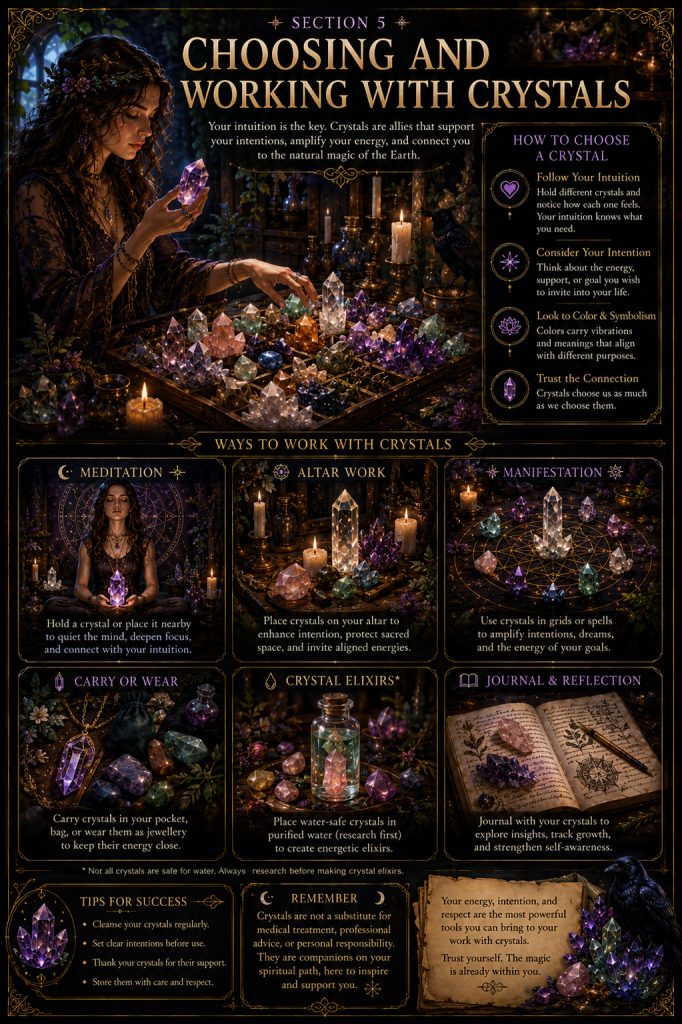
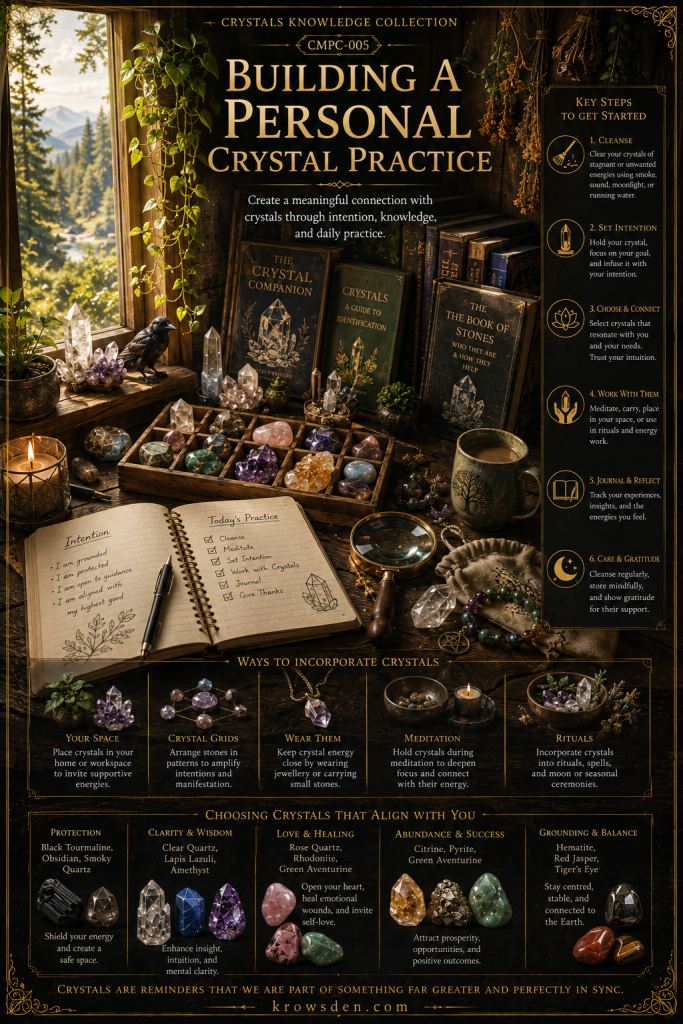
Building a Personal Crystal Practice
Crystals can be incorporated into everyday life in many different ways. Some people hold a crystal during meditation as a reminder to remain present and focused, while others include crystals on altars alongside candles, herbs, tarot cards, runes, or other ritual tools. Journaling with a crystal nearby can become part of a mindfulness routine, and many practitioners use crystal grids as symbolic arrangements that represent a specific intention or goal.
Some traditions recommend choosing crystals according to colour correspondences, planetary associations, zodiac signs, or the classical elements. Others encourage trusting intuition and selecting whichever crystal feels most appropriate in the moment. Neither approach is universally accepted, and many practitioners combine research with personal instinct, allowing both traditional knowledge and lived experience to shape their practice.
Ultimately, crystals are best viewed as meaningful companions rather than objects with guaranteed supernatural abilities. Their greatest value often lies in the way they encourage reflection, intention, learning, and a deeper appreciation of the natural world. Whether your interest is historical, spiritual, geological, or artistic, building a thoughtful crystal practice can become an enjoyable and rewarding journey that continues to evolve throughout your life.
Featured Crystal Collection
Throughout history, different crystals have been associated with unique qualities, traditions, and symbolic meanings. Some became symbols of protection, while others were linked to wisdom, prosperity, courage, intuition, or emotional balance. Although these associations vary between cultures and spiritual traditions, they have inspired generations of people to explore the rich folklore surrounding the mineral kingdom.
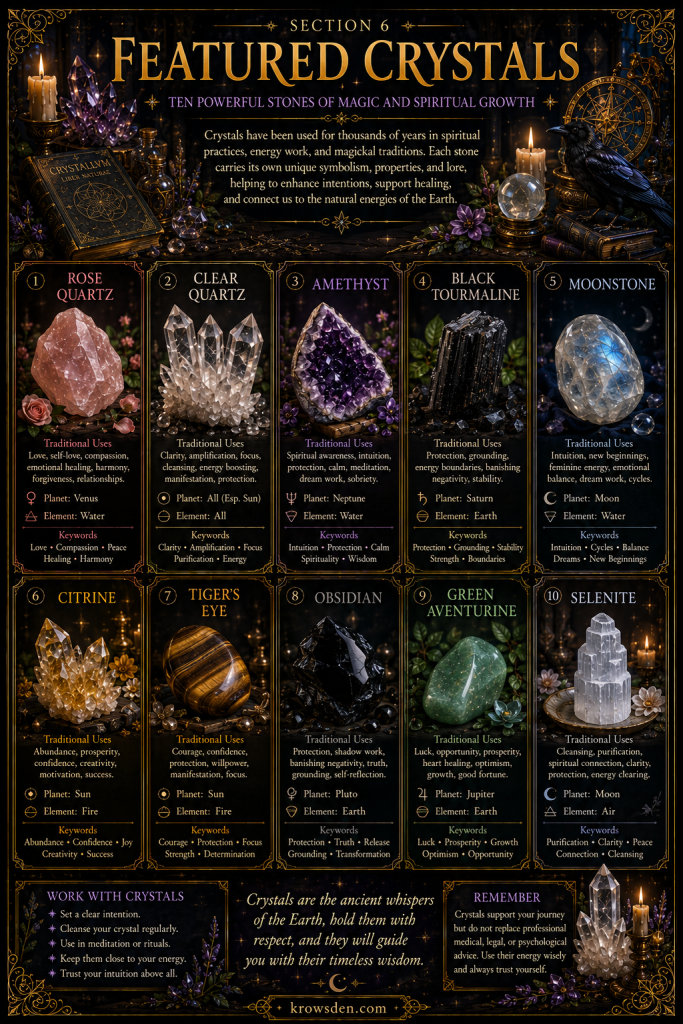
The Krow’s Den Featured Crystal Collection introduces ten of the world’s most recognised and widely used crystals. Together, they provide an excellent foundation for anyone beginning to explore crystal history, symbolism, and traditional magical practice. Each crystal has its own unique appearance, geological characteristics, historical background, and collection of traditional correspondences that have developed over centuries of folklore and cultural belief.
Rather than presenting crystals as objects possessing scientifically proven supernatural abilities, this collection explores the traditional meanings that have been passed down through history. By understanding where these beliefs originated and how different cultures interpreted various stones, readers can develop a greater appreciation for both the history of crystal magic and the remarkable beauty of the minerals themselves.
Building Your Crystal Library
The first collection features ten carefully selected crystals that are commonly found in historical writings, modern spiritual practice, and crystal collections around the world. Each reference card explores the crystal’s traditional symbolism, historical associations, mineral information, and common uses within magical and spiritual traditions.
- Rose Quartz — Love, compassion, and emotional healing.
- Clear Quartz — Clarity, focus, and amplification of intention.
- Amethyst — Protection, intuition, and spiritual awareness.
- Black Tourmaline — Grounding, resilience, and symbolic protection.
- Moonstone — Intuition, new beginnings, and lunar symbolism.
- Citrine — Confidence, prosperity, creativity, and motivation.
- Tiger’s Eye — Courage, determination, confidence, and personal strength.
- Obsidian — Reflection, truth, grounding, and transformation.
- Green Aventurine — Growth, opportunity, prosperity, and optimism.
- Selenite — Purification, clarity, peace, and spiritual reflection.
These ten crystals form the foundation of the Krow’s Den crystal library, but they are only the beginning. As the collection continues to grow, new crystal reference cards, historical research, traditional folklore, and magical correspondences will be added, creating an ever-expanding resource for collectors, historians, practitioners, and anyone fascinated by the rich traditions surrounding crystals. Whether you’re just beginning your journey or expanding an established collection, this library is designed to grow alongside your knowledge and curiosity.
Crystal Care and Safety
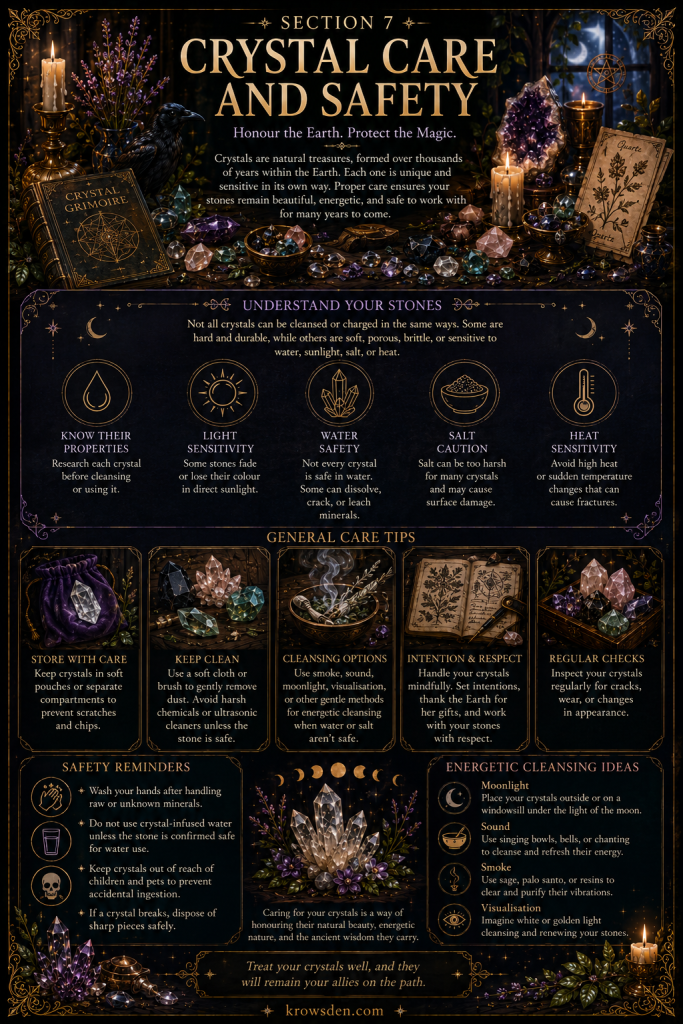
Crystals are remarkable natural minerals that have formed over thousands or even millions of years through geological processes beneath the Earth’s surface. While they are often admired for their beauty and symbolic meanings, they are also physical objects with unique mineral compositions and properties. Understanding how to properly care for your crystals helps preserve their appearance while ensuring they can be safely handled and enjoyed for many years.
Every crystal is different. Some minerals are extremely hard and resistant to damage, while others are surprisingly soft, brittle, porous, or sensitive to water, sunlight, heat, and chemicals. Because of these differences, there is no universal care method suitable for every crystal. A practice that is perfectly safe for one mineral may permanently damage another.
Learning about a crystal’s physical properties is just as important as learning its traditional symbolism. Responsible crystal collecting begins with understanding both the folklore surrounding a stone and the science that explains how it formed. By combining historical knowledge with proper mineral care, collectors and practitioners can appreciate crystals as both beautiful natural specimens and meaningful symbols within their personal practice.
Caring for Your Crystal Collection
Before cleaning or using any crystal, it is always worth researching the specific mineral. Some crystals, including Selenite, are water-soluble or easily damaged by moisture, while others may fade after prolonged exposure to direct sunlight. Certain minerals can scratch more easily than others, making careful storage important for preserving polished surfaces and delicate crystal formations.
Many people choose to clean their crystals using a soft cloth or gentle brush to remove dust and fingerprints. Others follow symbolic cleansing traditions such as placing crystals beneath the moonlight, using incense or smoke, surrounding them with sound, or simply taking a quiet moment to reset their intentions. These practices are based on personal belief and tradition rather than scientific evidence, but they remain popular within many spiritual communities because of the mindfulness and ritual they encourage.
Whether you collect crystals for their geological beauty, historical significance, or spiritual symbolism, treating them with care and respect helps preserve both the minerals themselves and the traditions connected to them. By learning about each crystal individually and following safe handling practices, you can build a collection that remains beautiful, meaningful, and enjoyable for many years while developing a deeper appreciation for the extraordinary natural processes that created these remarkable treasures.
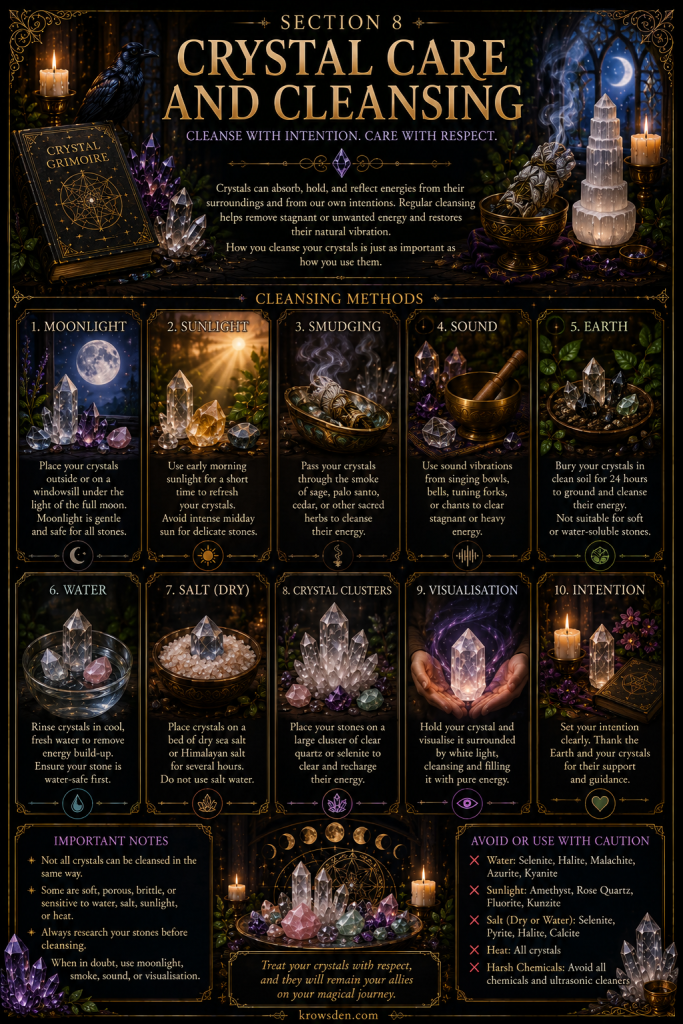
The Occult Crystal Grimoire
Throughout history, crystals have been woven into countless magical traditions, each culture developing its own interpretations of their symbolism and ritual use. While the earlier sections of this guide introduced the foundations of crystal lore, the Occult Crystal Grimoire explores the deeper layers of traditional correspondences that have surrounded these remarkable minerals for centuries. It is designed as a growing reference for those who wish to study the historical, symbolic, and magical associations of crystals in greater depth.
Rather than presenting one fixed system of belief, this grimoire brings together knowledge from a wide range of historical sources and occult traditions. Different cultures often assigned different meanings to the same stone, while modern practitioners continue to develop their own interpretations through study, experience, and personal practice. Understanding these varying perspectives allows readers to appreciate the rich diversity of crystal magic without suggesting that one tradition is more authentic than another.
As the Krow’s Den crystal library expands, each new crystal will become part of this growing grimoire. Individual entries will explore the folklore, historical uses, mineral information, symbolic meanings, and traditional magical correspondences that have made each crystal unique throughout history.
DOWNLOAD THE OCCULT CRYSTAL DECK HERE.
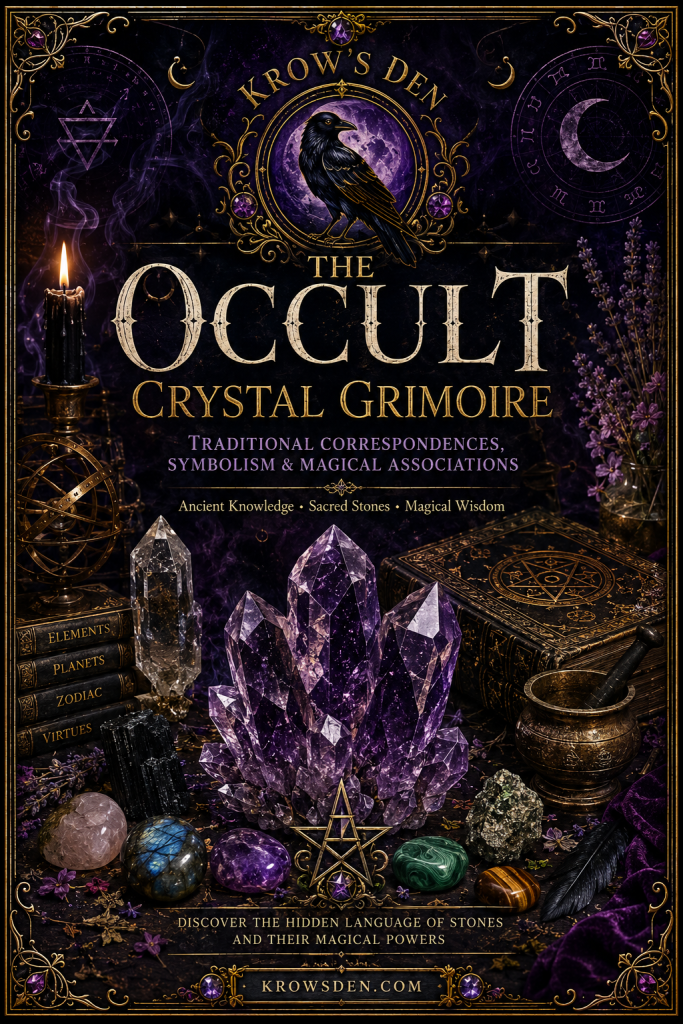
Expanding Your Knowledge
Each crystal entry within the Occult Crystal Grimoire is designed to go beyond simple meanings by exploring the many correspondences traditionally associated with that stone. These may include elemental associations, planetary correspondences, zodiac connections, colour symbolism, historical folklore, ritual uses, meditation practices, and other traditional beliefs recorded throughout history. Wherever possible, these associations will be presented alongside historical context so readers can better understand where these ideas originated.
The grimoire is intended to grow alongside the wider Krow’s Den learning centre. As new research is added, readers will discover connections between crystals and other magical subjects, including astrology, herbs, candle magic, sacred symbols, moon phases, planetary influences, divination, and ritual practice. Together, these topics form an interconnected system of traditional knowledge that has evolved across cultures for thousands of years.
Whether you are a collector, researcher, practitioner, or simply someone fascinated by the history of crystals, the Occult Crystal Grimoire is designed to become an ever-expanding resource that encourages curiosity, critical thinking, and lifelong learning. By studying both the historical traditions and the symbolism that continues to inspire people today, readers can develop a deeper appreciation for the enduring relationship between crystals, culture, and the magical imagination.
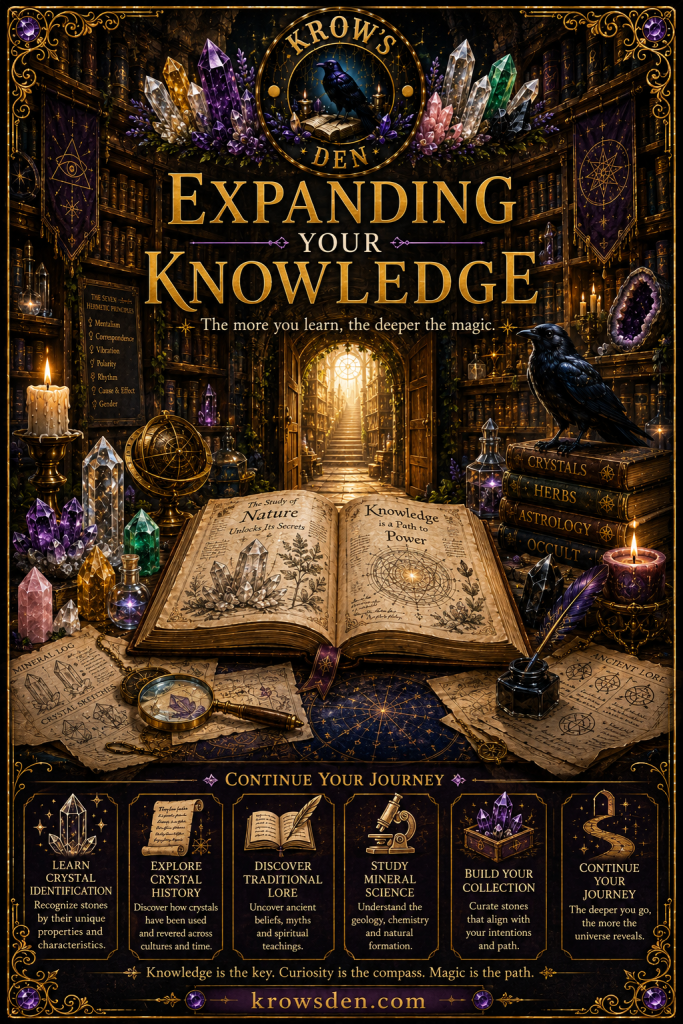
Continue Your Journey
The world of crystals is far larger than any single guide can fully explore. Every mineral has its own geological story, cultural history, and collection of traditional beliefs that have developed across different civilizations and spiritual traditions. The ten crystals featured in this collection provide a strong foundation, but they represent only the beginning of a much larger journey into the fascinating world of crystal lore.
As the Krow’s Den Crystal Library continues to grow, new crystal reference cards, historical research, and traditional correspondences will be added to expand this collection. Future entries will introduce both well-known and lesser-known minerals, exploring their geological origins, historical uses, folklore, symbolic meanings, and the roles they have played in magical and spiritual traditions throughout history. Each new addition is designed to build upon the knowledge:
Crystal Identification Guide
How Crystals Form
The History of Crystals in Ancient Civilizations
Choosing Your First Crystal
Astrology and Crystals
Birth Charts Explained
Planetary Correspondences
Lunar Phases and Crystal Work
Candle Magic for Beginners
Magical Herbs and Their Traditional Uses
Sacred Symbols in Traditional Witchcraft
Ancient Mythology and the Occult
Building Your Personal Book of Shadows
Beginner’s Guide to Witchcraft